
The Beginner’s Blueprint to AI Search Optimization: Mastering the Fundamentals
The more marketing changes, the more the fundamentals matter. AI search and SEO feel like two different games with their own tactics, but underneath they run on the same foundation. Get that foundation right and both of them get easier. It's like anything in business: build on solid ground first, and you've got a launchpad to grow from instead of a patch job you keep fixing.
What we learned by adding over a dozen sites in the last two months, in the course of our work, which encompassed over 40,000 pages and 300 million views
Invisible Foundations: Optimizing for Search Bots and AI Indexing
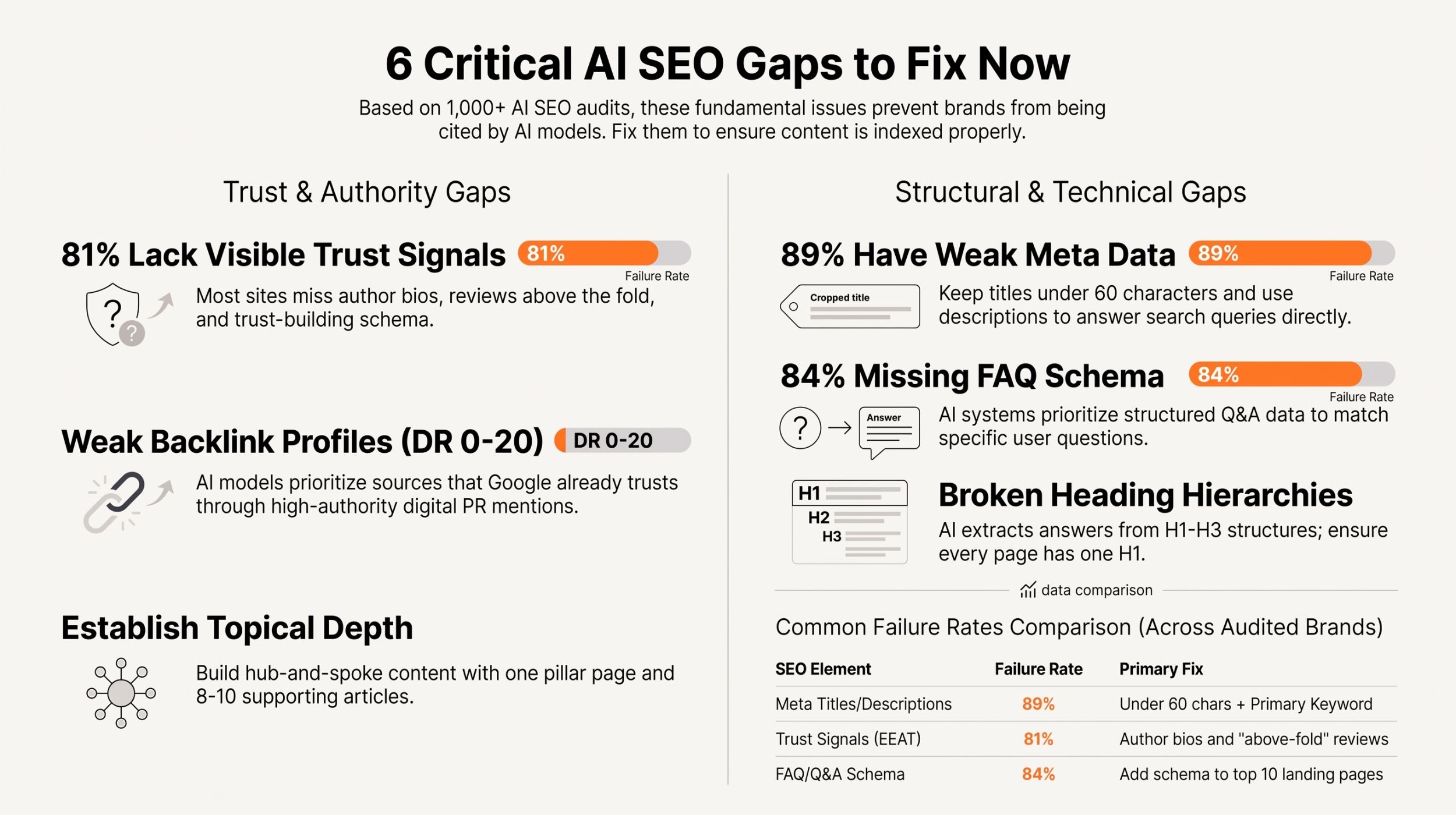
The majority of web optimization happens where peoples rarely see. Our audits revealed that a staggering 89% of brands had weak meta titles or descriptions, and 84% had neglected FAQ schema entirely. This represents a massive failure in basic communication with search engines.
The invisible layer
Buyers never see it. Models read it first.
| The invisible element | The fix |
|---|---|
| Meta titles | Limit to 60 characters. Place the primary keyword first, followed by the brand name. |
| Meta descriptions | Draft these as a direct, helpful answer to the specific search query. |
| FAQ & Q&A schema | Add FAQ schema to your top 10 landing pages. Answer 5–8 real user questions per page in plain language. |
The "Why" Behind the Fix
Meta titles are the absolute first thing Google indexes and remain the primary element AI models use to cite your page as a source. If this "ID card" is weak, your chances of being cited drop significantly. Furthermore, AI systems are designed to match user questions to structured data; when you provide FAQ schema, you are giving the AI a pre-formatted answer that it can easily plug into a search result.
Once the backend data is optimized for discovery, your next architectural requirement is the structural skeleton that users and bots use to navigate your information.
Structural Clarity: Using Headings and Links to Guide Understanding
If your website's structure is fractured, search systems cannot effectively "crawl" your content to map its meaning. The data highlights the severity of this issue: one audited site had 155 pages missing an H1 heading, while another had 4,038 internal links pointing to 301 redirects. These are not minor errors; they are massive "authority leaks" that confuse AI and degrade your site's performance.
Proper Heading Hierarchy
The One H1 Rule: Every page must have exactly one H1 heading. This is the primary signal AI uses to extract the core topic of a page.
H2 for Major Sections: Use H2s to divide the page into logical thematic blocks.
H3 for Sub-points: Use H3s for specific details nested strictly under an H2.
The Role of Anchor Text
Every post must link to 3–5 commercial or high-value pages.
Descriptive Text Only: One audit found 24% of outlinks had no anchor text. Use descriptive words to tell both humans and AI exactly what the destination page is about.
Instructional Command: You must audit your internal links monthly to ensure they point directly at final destinations. Avoid "301 redirect chains" within your internal structure at all costs; they leak authority and significantly slow down the indexing process.
With a sound structure in place, your focus must shift from how the page is built to the actual substance and depth of the content provided.
Topical Depth: Moving Beyond Surface-Level Content
AI search systems have evolved past rewarding surface-level keyword usage. They now trigger rewards based on "topical depth"—the measurable proof that a website is a subject matter expert. The audits revealed a widespread lack of consistency, including brands that went entire calendar years without publishing a single blog post. To combat this, you must adopt the Hub-and-Spoke model:
The Pillar Page (The Hub): A comprehensive, authoritative guide on a core topic.
Supporting Articles (The Spokes): 8–10 highly specific articles that link back to and support the pillar page.
AI search systems use topical depth as a reward trigger. By covering a subject from multiple angles through the Hub-and-Spoke model, you signal to the AI that your site is a comprehensive resource, making it significantly more likely to be cited for complex, multi-part queries.
Substantive content provides the "what," but to succeed in a competitive landscape, you must provide the "who" through visible proof of expertise and trust.
The Trust Layer: Establishing Authority and Credibility
In an era of anonymous, AI-generated noise, "Trust Signals" are the primary currency of the web. Our data shows that 81% of brands lack basic trust signals like author bios or reviews, and 89% suffer from a weak backlink profile (Domain Rating 0-20). If your site appears anonymous or unvetted, it will be ignored by modern search systems.
Critical Trust Signals
Author Bios on Every Article:
Primary Benefit: Establishes "human-in-the-loop" expertise, which AI models require to verify a source before citing it.
Reviews Above the Fold:
Primary Benefit: Provides immediate social proof that is visible without scrolling, signaling high quality to both bots and users instantly.
High-DR Mentions via Digital PR:
Primary Benefit: Acts as a third-party "vote of confidence" from established authorities that Google already trusts.
You must stop chasing a high volume of low-quality links. Your directive is to secure 5 high-DR mentions per quarter. This targeted approach is the only way to move out of the "anonymous" category and into the "authoritative" category.
The following checklist reinforces these requirements to ensure your site is built on a foundation of excellence.
Summary Checklist: The "ASAP" Optimization Guide
[ ] Audit Meta Titles: Ensure all titles are under 60 characters and follow the "Keyword + Brand" formula.
[ ] Refine Meta Descriptions: Rewrite descriptions to serve as a direct answer to the user's search query.
[ ] Standardize Headings: Ensure every page has exactly one H1 and a logical H2/H3 hierarchy (Fix the "155 missing H1s" error).
[ ] Clean Internal Links: Eliminate 301 redirects in your internal links; point all links to their final destinations.
[ ] Add Anchor Text: Ensure every internal outlink uses descriptive, keyword-rich anchor text.
[ ] Deploy FAQ Schema: Add 5–8 plain-language Q&As to your top 10 landing pages to capture structured AI queries.
[ ] Execute Hub-and-Spoke Content: Publish one pillar page and 8–10 supporting articles for every core topic you wish to own.
[ ] Install Trust Signals: Add verified author bios to all content and move customer reviews "above the fold."
[ ] Secure High-DR Backlinks: Target 5 high-authority mentions per quarter via Digital PR rather than low-quality volume.
By methodically executing these fundamentals, you are building a high-performing webpage that is architecturally prepared to be recognized, cited, and rewarded by the next generation of AI search.