The Choice Economy
Your customer's journey no longer starts with your website. It does not even start with search. Someone with a problem to solve now asks ChatGPT, or Perplexity, or Google's AI, and the machine answers with a short list of companies worth trusting. They pick one and get on with their day. They may never see your website at all.
Call it the choice economy. A machine now makes the shortlist, and your brand is on it or it is not there. For twenty years, winning meant ranking: climbing to the top of a page of blue links. That page is going away. Sixty percent of searches now end with no click at all. You no longer need to rank. You need to be the thing the machine quotes.
The machine is a corroboration engine, not a ranking engine
Here is the mechanism, watched up close, because the mechanism is the whole argument.
An AI assistant does not weigh your website against a rival's website and pick a winner. It does something closer to what you do when a stranger recommends a restaurant. It checks whether other people, people it already trusts, say the same thing. It is looking for agreement. Researchers have a plain word for what it is doing. Consensus.
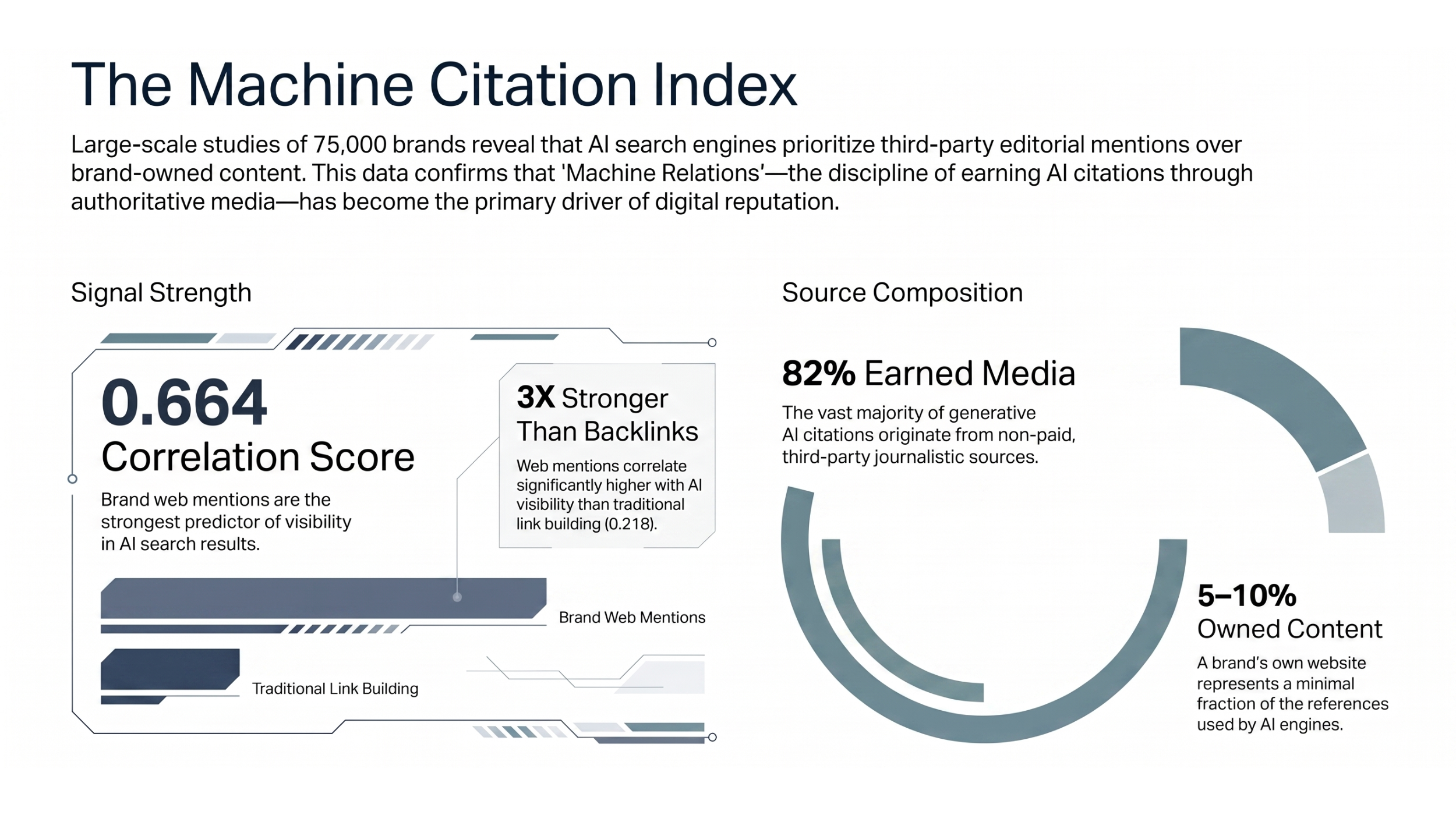
This changes the value of everything you own. Your blog, your landing pages, your carefully worded About section, all of it is self-interested by definition, and the machine treats it that way. In a McKinsey discovery survey, a brand's own website accounted for only five to ten percent of the sources an AI referenced. A peer-reviewed study from Fullintel and the University of Connecticut found the mirror image on the other side. Ninety-five percent of cited links came from earned, unpaid sources. Muck Rack's data puts earned media at eighty-two percent of citations. The range runs from eighty-two to ninety-five, and the direction never wavers. The machine believes the world about you far more than it believes you.
Ryan Law, who runs content at Ahrefs, describes how the model actually forms its picture. It learns a brand's authority "from words on the page, the co-occurrence of different terms and topics, and the context in which those words are used." Read that twice. The model is not counting your links. It is reading the room. It is noticing which words tend to sit near your name, and whether serious publications put them there.
Mentions dethroned the backlink
For twenty years the backlink was the currency of the web. A link from a strong site raised your standing. Whole agencies existed to buy, trade, and manufacture them. That economy is now mostly ceremonial.
Ahrefs studied more than seventy-five thousand brands and measured which signals actually predict whether an AI mentions you. The tool they used is a correlation coefficient, a number between zero and one where higher means a stronger relationship. The results reorder the entire field.
Brand signals
Mentions correlate. Links barely move.
| Factor | Correlation strength | Impact level |
|---|---|---|
| YouTube mentions | 0.737 | Critical |
| Branded web mentions | 0.664 | Very high |
| Branded anchors | 0.527 | High |
| Branded search volume | 0.392 | Moderate |
| Domain rating (DR) | 0.326 | Moderate / low |
| Backlink volume | 0.218 | Weak |
Look at the gap. A plain mention of your brand, a sentence in an article that may not even link to you, correlates with AI visibility at 0.664. Backlink volume, the thing an entire industry was built to sell, sits at 0.218. Mentions beat links by roughly three to one. The web stopped rewarding who points at you and started rewarding who talks about you.
This is the reductio that should end a lot of budget meetings. If the same money spent buying a link would buy a real conversation instead, and the conversation is worth three times as much to the only reader who now matters, why are you still buying links. A rule that fails that test is not a rule. It is a habit.
The YouTube signal nobody planned for
The strongest signal in the data is the one almost no marketing plan accounts for. A mention on YouTube, meaning your brand appears in a video's title, description, or spoken transcript, correlates with AI visibility at 0.737. It is the top signal across ChatGPT, Google's AI Mode, and AI Overviews alike.
The reason is not mysterious once you know where these models came from. OpenAI and Google trained on more than a million hours of YouTube transcripts, because a transcript is the cheapest large supply of natural human speech on earth. To the model, YouTube is not a video platform. It is a dictionary of how real people describe things. If your brand does not appear in that dictionary, you are missing from the machine's core memory of your own category.
The subtle finding matters more than the headline one. Raw mentions correlated more strongly than reach. A dense, expert-heavy transcript from a video almost no one watched can teach the model more about who you are than one viral clip. The machine is not counting the audience. It is reading the words. This is good news for a disciplined company and bad news for a loud one.
What the machine means by trust
Two terms carry most of the weight here, and both deserve plain English.
The first is entity recognition. The machine does not store your brand as a web address. It stores you as a thing in the world with traits attached, the way a person remembers "the sustainable coffee company" rather than a URL. Every time a credible publication describes you a certain way, it sharpens that picture. The words around your name become the traits the machine assigns you. Get mentioned near "reliable" and "expert" often enough, in serious places, and that is who you become in the model's memory.
The second is E-E-A-T, Google's shorthand for Experience, Expertise, Authoritativeness, and Trustworthiness. It is the machine's version of a background check. And a background check that you write about yourself is worth nothing. That is why a mention in the Wall Street Journal about you outweighs a thousand words you publish about yourself. One is testimony. The other is a résumé.
Which retires an old superstition. For years the "nofollow" tag, a small instruction that told search engines to ignore a link, made a mention feel worthless to marketers. Since 2019, Google has treated nofollow as a hint rather than an order. In the age of Machine Relations that hint is gold. A nofollow mention in Forbes tells the model far more than a followed link on a blog no human reads. The machine is measuring the quality of the company you keep, not the plumbing of the link.
The visibility cliff
Now the part that should scare the comfortable and encourage the hungry.
Consensus creates a cliff. Because the machine trusts brands the web already agrees on, small leads compound into total ones. Brands in the top quarter of web mentions earn roughly ten times the AI citations of the quarter below them. The gap is not gradual. Top-quartile brands average around one hundred sixty-nine AI mentions. The next quartile down averages fourteen. And twenty-six percent of brands are entirely invisible to AI, because they have no third-party footprint for the machine to find. There is nothing to reach a consensus about.
Here is the finding that frees you from the old scoreboard. Thirty-seven percent of the domains AI cites do not appear anywhere in the traditional top ten search results. The machine does not care whether you rank on page one of Google. It cares whether the web agrees you are worth citing. That means a company losing the ranking war can still win the citation war, because it is a different war with different rules. The door most companies think is bolted shut is simply a door they never tried.
The economics, said without softening
None of this is free, and pretending otherwise wastes everyone's burn.
Quality digital PR runs between three thousand and twelve thousand dollars a month in retainer. A single strong placement averages around five hundred nine dollars. These are real numbers, and a cautious CFO is right to ask what they return. The answer is the reason this essay exists. First Page Sage puts the median return on high-authority SEO and PR work at 748 percent. Content distributed through third-party outlets produced a median lift of 239 percent in AI visibility over the identical content hosted on a brand's own site. Same words. More than double the machine's attention, because of who was seen to say them.
So price the other side of the ledger too. The cost of invisibility. A brand sitting in the bottom half of web mentions is not underperforming in AI discovery. It is absent from it. Moving into the top quartile can multiply AI mentions roughly tenfold. That is not an incremental gain. That is the difference between being a name the machine offers and a name it has never heard.
The returns are real but they are not fast, and anyone who promises otherwise is selling you the old link-buying dream in new clothes. Movement usually begins in months three through six and compounds through months six to twelve. Authority is a deposit, not a purchase. It pays interest, which is exactly why you cannot cram it the week before you need it.
How we got here, in three short years
The shift felt sudden. It was not. It was three moves in a row.
What the metric became
Links were the proxy. Now it's being mentioned.
| Period | Primary KPI | AI search status |
|---|---|---|
| 2024 | Backlink volume / DR | Google’s link spam updates nullify the gains from low-quality link buying. |
| 2025 | Generative engine optimization (GEO) | AI Overviews arrive. Machines start weighing reputation signals over direct links. |
| 2026Now | Earned authority / mentions | Machine relations dominates. Earned media drives most AI citations. |
Google's June 2024 Link Spam update was the turn. It began voiding the gains from manufactured links, and it taught the market a lesson it is still absorbing. Three moves now carry a penalty rather than a reward. Topic mismatch, such as an electronic-signature product cited in a dating-advice article. High Domain Rating with no real human traffic, the signature of a link farm dressed up to look respectable. And self-serving roundup posts that mention rivals only to point every link at one tool. The machine learned to spot the trick, which means the honest move and the effective move are now the same move. That is the first time in the history of search that has been true.
The Machine Relations playbook
Enough diagnosis. Here is the offense, as five plays a team can actually run.
Supply narratives, not features. Reporters and models both want a story with a fact at the center, not a list of your product's virtues. Michael Johnson of Resolve puts the discipline exactly right. "The focus of your off-page SEO shouldn't be an algorithm. It should be humans." Serve the human and the machine follows, because the machine was trained on what humans found worth writing down.
Treat YouTube as infrastructure, not marketing. Transcripts feed the training data. A steady supply of expert video, even modest video, teaches the model your language. This is the highest-correlation signal in the entire dataset and the one your competitors are almost certainly ignoring. That combination, high value and low competition, is the definition of an opening.
Buy entity clarity through third parties. The machine believes what the Wall Street Journal says about you more than what you say about yourself, so put your effort where the model already looks. A place in a source of record is worth more than any amount of self-published volume.
Format so the machine can lift you cleanly. Give it objective sentences, real data, and clear structure. Muck Rack found that cited press releases carried two and a half times as many bullet points as the ones the machine ignored. Put the answer first, the way the machine retrieves it. Adding statistics and transparent method can raise the odds of citation by thirty to forty percent. You are reducing the work required to quote you. Do that, and you get quoted.
Tear down the wall between PR and SEO. They are no longer two departments. Earned mentions are now the raw material search visibility is built from. Ninety-four percent of B2B buyers already use AI in their research. If the PR team is not earning mentions, the SEO team has nothing to work with. Same goal, same scoreboard, one team.
Three theses for the boardroom
PR is the primary architecture. It is not a support function for search. It is the ground search now stands on. Without earned authority, technical optimization is scaffolding around an empty lot.
Consensus is the requirement. The machine prizes third-party validation because your own content, however good, cannot vouch for itself. Eighty-two percent and up of what it cites came from someone other than you.
Quality is the only scale that works now. One mention in a Tier-1 publication outweighs a thousand cheap links, and the cheap links may now cost you. The era of buying volume is over. The era of earning belief has started.
The reader changed. The test did not.
For all the newness, the thing being asked of you is old. A machine now reads your brand, summarizes it, and decides in a fraction of a second whether to hand your name to a stranger who is ready to buy. But it judges you by the same standard a good reporter always has. Third-party proof. Expert data. A reputation that stays consistent whether or not you are in the room.
So run the only test that now decides the account. If an AI engine weighed the consensus of the web about your company today, what would it conclude, and would it say your name out loud.
The old work was persuasion. The new work is corroboration. Your entity footprint is the only ranking left that matters, and it is being written right now, mostly by other people, whether you have earned a place in it or not.
Appendix: The Data Behind the Argument
AI Visibility Factors, by Correlation Strength
Brand signals
Mentions correlate. Links barely move.
| Factor | Correlation strength | Impact level |
|---|---|---|
| YouTube mentions | 0.737 | Critical |
| Branded web mentions | 0.664 | Very high |
| Branded anchors | 0.527 | High |
| Branded search volume | 0.392 | Moderate |
| Domain rating (DR) | 0.326 | Moderate / low |
| Backlink volume | 0.218 | Weak |
The Three-Year Shift (2024 to 2026)
What the metric became
Links were the proxy. Now it's being mentioned.
| Period | Primary KPI | AI search status |
|---|---|---|
| 2024 | Backlink volume / DR | Google’s link spam updates nullify the gains from low-quality link buying. |
| 2025 | Generative engine optimization (GEO) | AI Overviews arrive. Machines start weighing reputation signals over direct links. |
| 2026Now | Earned authority / mentions | Machine relations dominates. Earned media drives most AI citations. |
The Visibility Cliff, by Quartile
Mention distribution
The drop-off is a cliff, not a slope.
| Segment | Average AI mentions | Note |
|---|---|---|
| Top-quartile brands | ~169 | Roughly 12x the quartile directly below it. |
| Second-quartile brands | ~14 | Still visible, but an order of magnitude back. |
| Bottom 50% | Effectively invisible | No third-party footprint for a model to cite. |
Key Figures at a Glance
The numbers
Your site is not the source. Everyone else is.
| Where the citations come from | |
|---|---|
| Citations drawn from earned media | 82–95% |
| Brand-owned share of AI sources | 5–10% |
| AI-cited domains absent from the traditional top 10 | 37% |
| Google searches ending in zero clicks | 60% |
| B2B buyers using AI in research | 94% |
| What it costs, what it returns | |
| Visibility lift from third-party distribution | 239% median |
| Median SEO / high-authority ROI | 748% |
| Average cost per quality backlink | ~$509 |
| Quality digital PR retainer range | $3–12k / month |
| What makes content citable | |
| Bullet points in cited vs. ignored press releases | 2.5x more |
| Citation-probability lift from adding statistics | 30–40% |
| YouTube transcripts used in model training | 1M+ hours |
The Evidence Base (20 Supporting Sources)
Ahrefs: Study of 75k brands confirming 0.664 correlation for branded web mentions.
Muck Rack: "Generative Pulse" report showing 82% of citations come from earned media.
McKinsey: Survey showing brand sites account for only 5–10% of AI search sources.
Stacker/Scrunch: Controlled study showing 239% median lift in visibility via third-party distribution.
Ahrefs: December 2025 study identifying YouTube mentions as the top signal (0.737 correlation).
University of Toronto (Chen et al.): Empirical study finding "systematic bias" toward earned media in AI.
Fullintel/UConn: Peer-reviewed study showing 89%+ of cited links are from earned media.
Berkeley (Kumar et al.): GEO-16 framework study emphasizing third-party authoritative domains.
BuzzStream: Analysis of 50 SaaS sites showing "Link Spam" updates nullified low-quality link gains.
Canvas PR: Analysis of Google's 2019 "hints" update regarding nofollow brand mentions.
Google Search Central: Official blog on evolving nofollow attributes as ranking hints.
First Page Sage: Report showing a 748% median ROI for high-authority SEO campaigns.
Princeton/Georgia Tech (Aggarwal et al.): Research showing statistics improve AI visibility by 30–40%.
arXiv (Zhang et al.): Study finding 37% of AI-cited domains are absent from traditional top-10 search results.
Moz: 2026 analysis showing 88% of AI citations do not appear in organic search top 10.
Forrester: 2026 Buyer Insights showing 94% of B2B buyers use AI for research.
Seer Interactive: Study showing weak correlation (0.10–0.25) for traditional link metrics in ChatGPT.
Kevin Indig: Research showing 0.334 correlation between brand search volume and AI visibility.
Reboot Online: Proprietary data showing average DR of digital PR coverage is 61.
WorldCom Group: Report stating 90% of citations driving visibility come from earned media.
Prepared by CAMINO5. Machine Relations is a discipline defined by Jaxon Parrott, Founder of AuthorityTech.