
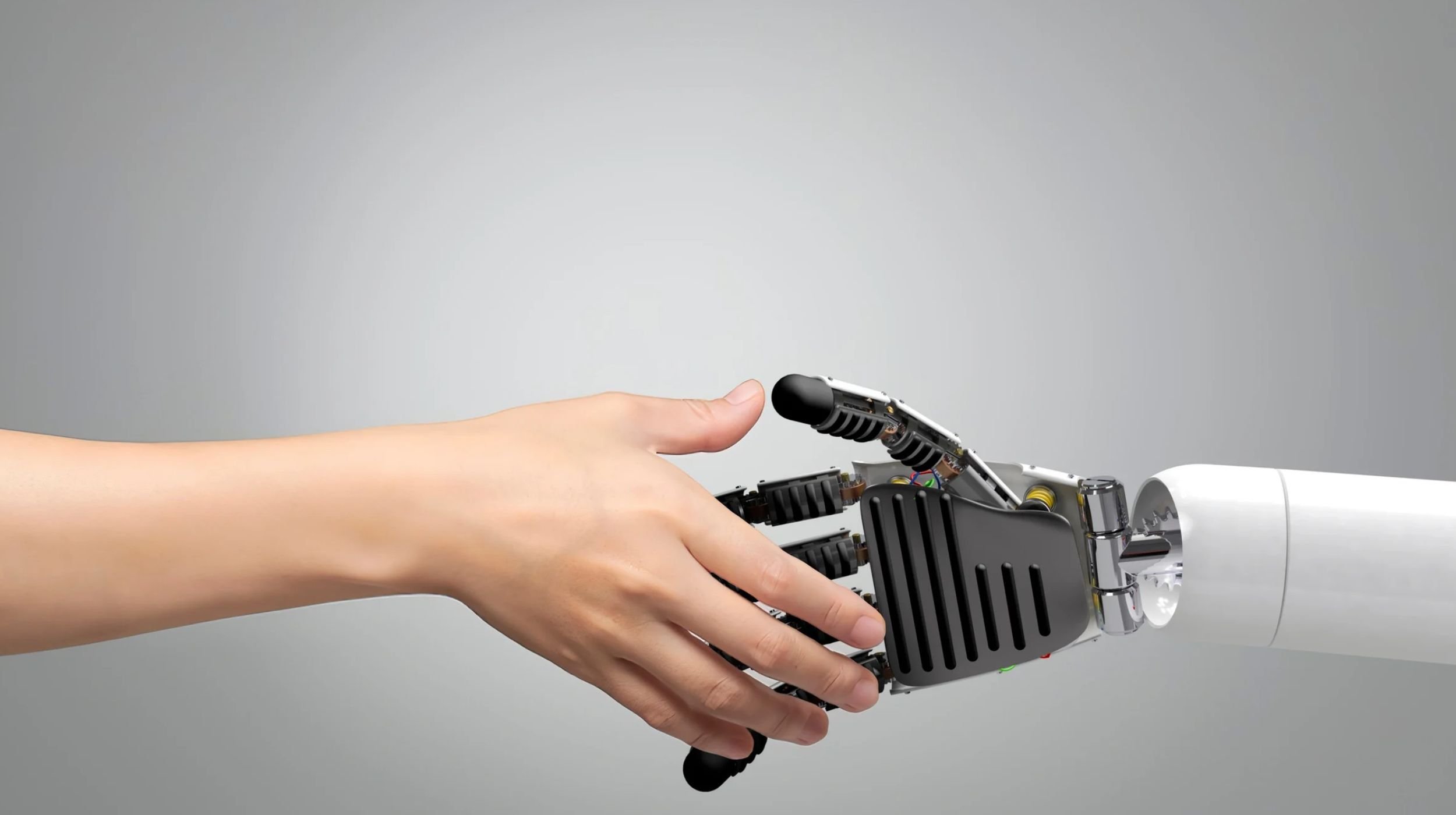
For marketing leaders who have heard "nobody trusts AI" used as a reason to wait on AI search, and want to check whether that holds for their own customers.
If someone in your last planning meeting argued against investing in AI search because "Americans don't trust AI," they had real data behind them. Morning Consult's AI Trust Report, published in May, found that 63% of Americans trust AI only a little or not at all. Pew Research found in June that most Americans are skeptical of AI and not confident that companies will develop it responsibly.
The same research also shows that nearly half of Americans now use AI chatbots, and that use is rising while trust falls. Whether low trust should change your plans depends on a narrower question than the headline answers: are your customers using AI to research what you sell, and do you show up when they do?
AI trust and AI search
Distrust doesn’t stop AI search. It sends people looking for proof.
- 65% have used an AI search tool in the past six months
- 15% trust the information AI search gives them “a lot”
- 63% double-check AI search results against news and review sites
Where they check is part of your visibility
-
Reviews
Recent, specific, on the sites your buyers already use.
-
Coverage
Credible publications that describe you accurately.
-
Your own pages
Clear, current and consistent with what others say.
say AI results feel like a “walled garden” that’s hard to verify. Make yours easy to confirm.
Skeptical users go looking for proof. The brands with proof win.
Source: Morning Consult survey of 2,202 US adults for Yelp, published April 14, 2026. All four figures are shares of all respondents.
What the research actually says about trust
The headline number is real. It is also only one of three different kinds of trust.
Morning Consult's report, based on a nationally representative survey of U.S. adults and continuous tracking of more than 3,000 brands, found that the share of Americans who say they do not trust AI at all rose 9 points to 36% since August 2025. AI now ranks 10th out of 198 tracked categories in awareness-adjusted distrust, alongside tobacco, chemicals, dating apps, and crypto. That is not a number to brush aside.
The useful part of the report is that it separates trust into three kinds, and they point in different directions.
Trust in AI companies is low. Seven of the ten leading AI brands lost net trust over the past year. Only Gemini, Anthropic, and Apple Intelligence gained, and only 12% of Americans said AI industry leaders are generally credible and trustworthy.
Trust in the AI industry's effect on society is low, for specific reasons. The top negative associations were spreading misinformation (39%), threatening jobs (38%), collecting and misusing personal data (33%), and training AI on people's data without consent (32%). These are concerns about what AI does to society, not about whether a tool helps someone compare two products.
Trust in personal use is much higher. Self-reported chatbot use rose from 31% in May 2024 to 49% in April 2026, and expected impact was net positive in healthcare, daily life, and education. Americans also said they trust exactly three groups to use AI responsibly: themselves, their family, and their friends. Every institution, including AI companies, large tech firms, and the federal government, scored negative.
Pew's June 2026 survey points the same way. About half of U.S. adults now use AI chatbots, up from about a third in 2024, and a quarter use them daily. Yet 59% said they were not confident in U.S. companies to develop and use AI responsibly.
Use and trust are moving in opposite directions
People are relying on AI more even as they trust the industry less.
Morning Consult found that net trust in AI peaked in October 2025 at around 12 and has since fallen to 8.5. Over roughly the same period, chatbot use climbed from about a third to about half of Americans. The report links the trust decline to late-2025 news about AI-related layoffs, privacy and mental health incidents involving chatbots, and deepfakes.
This is the finding that matters most for marketing. A person's decision to ask an AI tool which software, product, or service to consider has very little to do with how they feel about AI companies as institutions. Accenture's 2026 Consumer Pulse survey of more than 25,000 consumers found that 74% would trust a personal AI agent more than their best friend to make a purchase on their behalf. People can distrust the industry and still lean on its tools.
Low trust changes how people use AI search, not whether they use it
Skeptical users check the answer. That makes the sources they check part of your visibility.
A Morning Consult survey of 2,202 U.S. adults, conducted with Yelp and published in April, found that 65% had used an AI-powered search tool in the past six months, but only 15% trusted its information "a lot." Sixty-three percent said they double-check AI search results against other trusted sources such as news sites and review platforms, and 51% said AI results feel like a "walled garden" that is hard to verify.
That reframes the trust question in a practical way. Low trust does not keep people out of AI search. It sends them from the AI answer to the sources that can confirm it. If your brand appears in the AI answer and is also backed by credible reviews, coverage, and clear information on your own site, skepticism works in your favor. If you appear only in the AI answer, or not at all, it does not.
Distrust does not keep people out of AI search. It sends them looking for proof, and the brands with proof win.
Your customers are not the national average
Trust varies sharply by income, age, location, and country.
Morning Consult's demographic splits are some of the most useful and least quoted findings in the report. Net trust in AI was highest among people earning $100,000 or more (+23.7), urban residents (+17.9), college graduates (+17.9), and Millennials (+17.7). It was lowest among Gen Z (+4.1), political independents (+5.9), rural residents (+6.8), adults without a college degree (+8.3), and women (+8.7). The gap between the highest- and lowest-income groups was 33 points.
Geography matters even more. The low-trust picture is largely a U.S. and English-speaking-world pattern. ChatGPT's average net trust across the U.S., U.K., Canada, and Australia was 9.7, roughly 40 points below the average in the other markets tracked. By continent, ChatGPT's net trust ranged from +61.8 in Africa and +51.1 in South America to +20.3 in Europe and +6.7 in Australia. The U.S. ranked 21st of the 28 countries tracked.
For a B2B company selling to finance, technology, or professional services, or a brand with a large international customer base, the national distrust figure describes your buyers less well than it describes the average. For a brand whose customers skew rural, younger, or lower-income, it is more relevant.
Most opinions are still forming
For many AI brands, most Americans have not decided what they think yet.
Morning Consult noted that about three-quarters of Americans had no firm opinion on several AI brands, and even the best-known brands had only recently crossed the point where half of Americans held any view. That matters for marketers because people who have not made up their minds about AI are still forming habits around how they research purchases. Brands that are visible and well supported in AI answers during that period are more likely to become the default answers as habits settle.
The numbers behind the argument
AI use and AI trust
About half of Americans now use AI chatbots. 63% trust AI only a little or not at all.
Use is rising while trust is not. Most AI search users check answers against sources they already trust, so the sources AI cites matter as much as the answer.
| Finding | Figure | Source |
|---|---|---|
| Trust and use · US adults | ||
| Americans who trust AI only a little or not at all | 63% | Morning Consult AI Trust Report, May 2026 |
| Self-reported AI chatbot use, May 2024 versus April 2026 | 31% vs 49% | Morning Consult AI Trust Report, May 2026 |
| US adults who use AI chatbots at least occasionally | ~49% | Pew Research Center, June 17, 2026 |
| US adults who use AI chatbots daily | about 1 in 4 | Pew Research Center, June 17, 2026 |
| AI search · US adults | ||
| Used an AI search tool in the past six months | 65% | Morning Consult with Yelp, April 2026 |
| Trust AI search results “a lot” | 15% | Morning Consult with Yelp, April 2026 |
| AI search users who double-check results against other trusted sources | 63% | Morning Consult with Yelp, April 2026 |
| Agents and markets | ||
| Consumers who would trust a personal AI agent more than their best friend to buy for them, 16 countries | 74% | Accenture Consumer Pulse, June 2026 |
| ChatGPT net trust, average of the US, UK, Canada and Australia; other markets average roughly 40 points higher | 9.7 | Morning Consult AI Trust Report, May 2026 |
Morning Consult’s trust report surveyed 1,048 US adults; Pew surveyed 5,119 US adults in February 2026. Net trust is the share who trust a brand minus the share who distrust it.
These are surveys of stated attitudes and self-reported behavior, which can differ from what people actually do.
The ledger: what waiting costs and what investing costs
Both choices carry risk. Be clear which one you are taking.
The concerns in this research are real and should shape how you invest. Morning Consult found privacy was the area where Americans expected AI to do the most harm (net -24), followed by democracy and elections (-16). The report also notes that growing skepticism could increase political pressure for AI regulation, which is a forward risk for the whole category. And Gen Z, the generation with the lowest trust score, will be buying for decades.
Investing in AI search visibility costs time and attention in a channel whose rules are still changing. Waiting costs something too: if your competitors are already named in the answers your customers read, every month of delay is a month they spend becoming the default. What makes the decision easier is that most of the work, accurate information, strong reviews, credible third-party coverage, and clear pages, helps with skeptical humans and AI tools at the same time.
Three failure modes to watch for
Each one turns a reasonable concern into a bad decision.
The first is deciding from the headline: using a national average to make a decision about a specific customer base. The second is confusing sentiment with behavior: assuming that because people distrust AI companies, your customers are not using AI to research you. The third is treating the decision as permanent. Trust and usage figures have moved substantially in less than two years, and markets that looked skeptical have changed quickly.
See what AI search says about your brand.
Run a quick visibility check before making a strategy call.
Check Your VisibilityTest small before you decide
Check your own customers and category before committing either way.
Pick three to five of the questions your customers ask most before buying, and check how ChatGPT, Perplexity, and Google's AI results answer them today. At the same time, compare your customer base against the demographic and geographic splits above. If your customers look like the higher-trust groups and your competitors already appear in the answers, the case for acting is strong. If neither is true, you have learned that you can move more slowly, at low cost.
Then write down what you checked and how, on one page, so a colleague can repeat the check next quarter without you. Trust and usage are still moving, and a repeatable check is worth more than a one-time verdict.
What this likely means over the next 6 to 18 months
Expect use to keep rising, trust to stay contested, and verification to matter more.
If current trends hold, more people will use AI tools to research purchases even as concern about AI companies and AI's effect on society stays high. That combination most likely means more AI-assisted research paired with more checking, which raises the value of the sources people use to verify an AI answer: reviews, credible coverage, and clear, accurate company information. Policy and regulation could also change how AI tools present commercial information, so brands that rely on accurate, verifiable claims are likely to be in the safest position.
If you want to know whether your category is already being shaped by AI search, Camino5's AEO Ready Score takes about 90 seconds.
AI search is already part of the buyer journey.
See where your brand shows up before the market gets harder to read.
Check Your VisibilityHow to start today
Map your customer base against Morning Consult's splits on income, age, location, and country. This takes about 30 minutes with data you already have, and it tells you more than the national average can.
Ask ChatGPT, Perplexity, and Google's AI results the five questions your customers ask most before buying, and note whether you and your top three competitors are named.
List the review sites and publications your customers would use to double-check an AI answer about your category, and confirm your information there is accurate and current.
Check Google Search Console for queries where your rankings are stable but clicks are falling. That pattern suggests AI answers are absorbing research that used to reach your site.
Write the whole check on one page and schedule a colleague to repeat it next quarter, so the decision follows the data as it changes.
People do not have to trust the AI industry to rely on its answers; they only have to use it, and the brands that will matter most are the ones those answers can name and the sources behind them can confirm.
Still on the fence about whether AI search deserves your attention? Take the free AEO Readiness Assessment — six questions, 90 seconds, and you'll know whether your category is actually being shaped by AI today or whether you can safely wait.