
The Retail Funnel Didn't Break. It Got Bypassed.

Quick Facts:
83% zero-click when Google AI Overview appears
65% of all Google searches end with no click to any website
72% of AI shoppers use it as their primary research tool
The retail buyer journey your marketing strategy was built around assumed one thing: that shoppers would visit your site during the research phase. That assumption is no longer safe. This article explains what changed in retail search behavior, what the data shows, and what you can do about it.
When the Numbers Move and Nothing Explains Why
Most retail marketing leaders dealing with this problem share the same experience. Traffic is down. Pipeline is thinning. The rankings look fine. Nothing is broken but it is not healthy either.
That last part is what makes it hard. A ranking loss gives you a diagnosis. You know where to look. You can build a plan. But a lot of retail teams right now are sitting with something more disorienting: the metrics are moving in the wrong direction and there is no obvious reason why. The content is there. The product pages are indexed. The domain is in good shape. And yet fewer customers are coming in.
This is not a technical SEO problem. It is a structural one. And the data is specific about what is driving it:
Around 60 to 65 percent of Google searches now end with no click to any website, according to Go Fish Digital
For queries where an AI Overview appears, that jumps to approximately 83 percent zero-click, with organic CTR dropping 34 to 61 percent even when rankings have not moved
For conversational AI interfaces like ChatGPT or Perplexity, zero-click behavior reaches roughly 93 percent
97 percent of retailers say they have already implemented AI or have a program in development, according to Capital One Shopping, meaning your entire competitive set is feeding into these systems right now
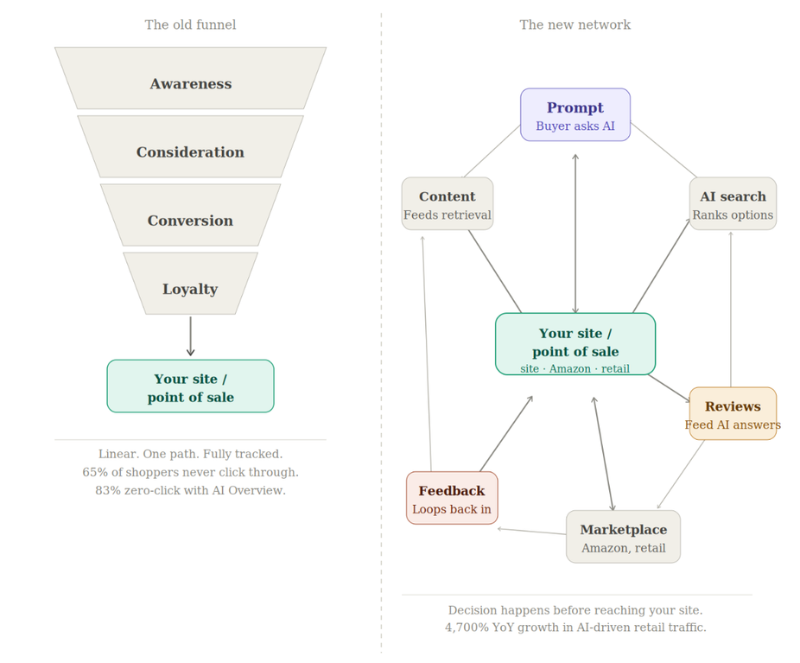
The funnel model that most retail marketing strategies are built on assumed shoppers would spend time on your site during the consideration phase. They would read your product descriptions, your comparison pages, your category content. They would return a day later with a more specific query. You would see that whole journey in your analytics: sessions, pageviews, assisted conversions. A trackable path from first touch to purchase.
That path still exists for some shoppers. But a growing share of them are taking a different route entirely. One that bypasses your site at the exact moment they are forming a shortlist.
The Research Phase Has Moved
Think about what retail considerations used to look like. A shopper has a need. They search. They click a few results, read, compare, maybe bookmark something. They return the next day and go deeper. You could see all of it. It mapped to a funnel.
Now that same shopper opens an AI interface and asks the question directly. The AI pulls from your site, your competitors, review platforms, marketplaces, and third-party sources simultaneously. It synthesizes them into a single answer. It shortlists options. It forms a recommendation.
That entire process, what used to be three or four sessions of research across two or three days, now happens in a single conversation. And none of it touches your funnel.
Commerce analysts at FTI Consulting describe this as AI replacing traditional retail sales funnels with AI-driven shopping loops. The funnel was already an imperfect model of shopper behavior. AI search has compressed the steps it was trying to capture into a single moment that your analytics were never built to see.
What the Data Actually Shows
The numbers are no longer projections. This is current behavior across a significant share of buyers.
Go Fish Digital data shows that around 60 to 65 percent of Google searches now end with no click to any website. For queries where an AI Overview appears, that number jumps to approximately 83 percent, with organic click-through rates dropping between 34 and 61 percent even when rankings have not moved. For conversational AI interfaces like ChatGPT or Perplexity, zero-click behavior reaches roughly 93 percent. Almost all intent is resolved without a site visit.
The buyer adoption side is just as significant. According to Capital One Shopping research:
76 percent of consumers say they want AI-powered shopping assistants
63 percent want to shop with help from generative AI
Between 58 and 69 percent have already used generative AI to find product recommendations
Roughly 4 in 10 US consumers used AI to shop in Q1 2026
In 2025, nearly half of all consumers, 49 percent, reported using AI for shopping at some point. They spent an average of $408 via AI across approximately 8 transactions, according to Partner Centric.
Where the Retail Consideration Stage Is Going
The specific place this matters most is consideration. That is where the retail funnel is losing the most ground, and where AI has moved fastest.
Bain research indicates that around 80 percent of consumers rely on zero-click results, summaries and answer boxes, for at least 40 percent of their searches. The middle of the funnel is collapsing into a single synthesized response that a shopper reads, trusts, and acts on. Deloitte-linked survey work reported by Digiday puts the retail behavior in practical terms:
56 percent of US consumers plan to use AI chatbots to compare prices and find deals
47 percent use AI to summarize product reviews before deciding
72 percent of shoppers who already use AI regularly treat it as their primary tool for researching products and brands, according to Capital One Shopping
When shoppers are asked why, Partner Centric data is consistent: 73 percent cite better product recommendations, 60 percent cite speed, and 54 percent say AI simply makes shopping easier. Nearly a third explicitly value that AI synthesizes reviews for them. On average, consumers said AI saved them about 6.2 hours of shopping time in 2025. And 94 percent were happy with AI-assisted purchases.
That satisfaction rate compounds. Shoppers who have a good AI-assisted purchase experience become more likely to start their next purchase the same way. The behavior reinforces itself every time it works.
The Mention Is the New Impression
There is a specific concept worth naming precisely, because it changes how retail brands should think about visibility.
The new mid-funnel impression is not a banner view or a sponsored placement. It is whether the AI names your brand in the answer. That is where retail influence happens now. Not when someone clicks to your product page. When the AI includes you in a synthesized response that a shopper reads, trusts, and acts on without ever leaving the interface.
Analysts at Go Fish Digital note that traffic compression does not necessarily indicate declining interest. Influence has moved upstream into AI-generated answers that users read but rarely click. Your classic funnel metrics, sessions, multi-channel funnel paths, assisted conversions, cannot show you whether you were mentioned in the summary that shaped last week's purchase decision. That layer is completely invisible to standard retail dashboards.
The Loyalty Problem Retail Is Not Ready For
The feedback loop that closes the AI shopping cycle has an implication for retail brand loyalty that most teams have not fully reckoned with.
81 percent of retail executives believe agentic commerce will weaken brand loyalty by 2027, according to TryAivo research. The reasoning is direct: AI agents optimize for value and fit at the moment of decision. They are not loyal to retail brands shoppers have bought from for years. They re-evaluate the whole category every time a shopper asks.
Your email program, your loyalty points, your retargeting sequences were built for a model where the shopper stays in your orbit between purchase cycles. That model depends on being top of mind. AI does not rely on top of mind. It relies on what is best supported, best reviewed, and most credible in the retrieval set right now.
This does not mean brand is irrelevant in retail. It means what brand has to do has changed. A retail brand that appears consistently in AI answers, that generates strong product reviews AI can pull from, that holds a clear and credible category position has real durable equity in this environment. A brand that relies primarily on email open rates and pixel-based retargeting to drive repeat purchase is more exposed than it knows.
The Retail Demand Is Still There
Here is the part that tends to get lost in these conversations.
AI-driven traffic to US retail websites increased roughly 4,700 percent year over year, according to Capital One Shopping. Retail demand did not disappear. It got rerouted. Shoppers are still there, still researching, still making decisions. They are just doing it through a different interface. AI platform-driven e-commerce is forecast to exceed $144 billion by 2029, about 8.8 percent of total retail e-commerce, according to eMarketer.
Your funnel metrics are shrinking not because shopper interest disappeared, but because AI absorbed the retail journey before it reached your site. The problem is not traffic. It is where the purchase decision is now being made. The retail brands that understand that early are not just protecting existing position. They are picking up ground from competitors who are still optimizing for a journey their shoppers have already left.
Where to Start
You do not need to rebuild your retail strategy. You need to extend your visibility into the layer of the shopper journey that is now happening before anyone reaches your site.
Run a prompt audit on your product category. Open ChatGPT, Perplexity, and Google with AI Overviews active. Ask the questions your shoppers most likely ask: what is the best option in your category, how to choose between the main alternatives, what people say about your brand specifically. Write down who is being named. If you are not in the answer, that is the gap you are working with.
Restructure your top pages to answer questions early. Go into Google Search Console and pull your top 20 traffic-driving pages. Look at the queries they rank for. Then open each page and ask: does this page answer that question directly in the first two or three paragraphs? Retail content that answers product questions plainly and early is what AI extracts and cites. Content that buries the answer does not make the cut.
Build your product review surface systematically. Identify where your category reviews live: Google Business Profile, Trustpilot, or the retail-specific directories your shoppers actually use. Set up a simple post-purchase review request if you do not have one. Focus on getting recent reviews that mention specific use cases and product outcomes. Those attribute-level details are what AI pulls when building a synthesized shopping answer.
Track branded search as a proxy for AI visibility. You cannot yet directly measure AI mention share with most standard tools, though platforms like Profound and Semrush are building toward it. In the meantime, branded search volume is a useful proxy. If AI is naming your brand in retail answers, shoppers will often search your name directly before visiting. Rising branded search alongside flat organic traffic is a signal that AI visibility is working even when standard attribution cannot show it.
Treat your content as retrieval infrastructure, not just ranking infrastructure. Content that ranks well has always mattered. Content that AI can extract, trust, and cite in a retail context requires a few additional qualities: clear authorship, direct answers to specific product questions, consistent category positioning, and accurate verifiable claims. Review your content calendar and ask whether new pieces are being built with retrieval in mind. The overlap with good SEO is large. The gaps matter.
If AI is rerouting your shoppers, the first step is seeing where they're being sent instead. Run your free Invisibility Score to see exactly how AI platforms answer the buying questions in your category. About 30 seconds, delivered by email.