AEO Is Not About Getting Cited.It’s About Being Credible When You Are.

Quick Facts:
Brand-name queries get 50% citation share.
General queries drop your citation share to 22%.
54% of AI answers find tension with your reviews.
AI search behavior is moving faster than any one team can reasonably track. I read seven research papers from the last two months, removed the outliers, and averaged the middle. This is what the data shows, and what I am telling clients.
Too Much Research, Not Enough Signal
The AEO research landscape is loud right now. Before diving into the data, here is why this synthesis matters and what we did to make it useful.
Right now there are studies covering 2 billion prompts. Audits of 3,000 websites. Papers that run 47 slides before they reach a single thing you can act on.
None of that is wrong. It is just too much for any team to parse on top of everything else they are already doing.
So I read seven of the most recent ones, pulled out what held up across all of them, and left the noise behind. What follows is the signal.
The research is not the problem. The volume is. Seven papers in, the patterns are clear enough to act on.
ChatGPT Does Not Make One Search. It Makes Several.
Most people assume ChatGPT runs one search and builds an answer. It does not. It runs a sequence, and where your brand appears in that sequence determines how much influence you have.
When ChatGPT answers a question with web search on, it runs a sequence of calls. Each one has a different job. Understanding that sequence is where AEO strategy actually starts.

Data from 1,690 brand-direct prompts. Each bar shows which source type got fetched at that stage of the search sequence.
The first call is about getting oriented. Media and publisher content show up in 42% of those first fetches. Your brand site shows up in 28%. Someone else is usually framing the answer before your content enters the picture.
The second call is where your site has the most influence. It appears in 43% of second-call fetches. This is the verification stage, where ChatGPT is checking claims and looking for direct answers. If your content is thin or hard to read quickly, this is the moment you lose.
By the third call, the mix shifts toward reviews and communities. G2, Trustpilot, and Reddit are each pulling significant share. ChatGPT is now checking whether your story holds up against what other people say about you.
Discover. Verify. Validate. Every time.
Your site peaks at call 2. That is the verification moment. Get that stage right and you control the narrative. Miss it and you do not.
Who Actually Gets Cited in the Answer
Getting fetched and getting cited are two different things. This is where the data shows who actually shapes the final answer a buyer reads about your brand.
Fetches tell you what ChatGPT reads. Citations tell you what ends up in the answer it gives your potential customer.
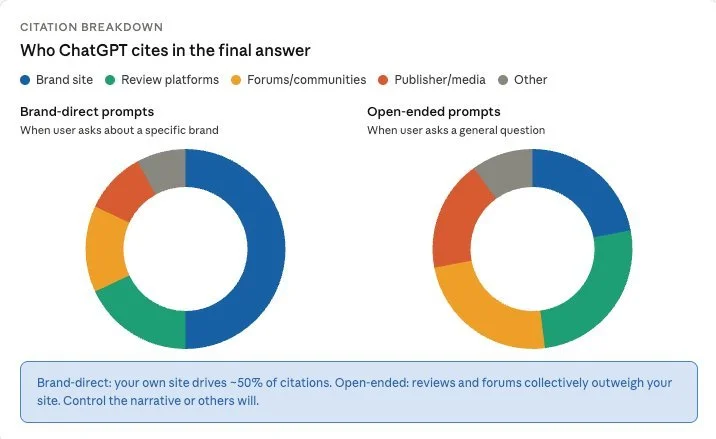
Citation share by source type across 3,380 prompts. Brand-direct on the left, open-ended on the right.
When someone asks about your brand by name, your site accounts for about half the citations. That is the good news.
When someone asks a general category question, without naming you, your share drops to 22%. Reviews jump to 26%. Forums jump to 24%. At that point, G2 and Reddit together carry more weight than your website.
| Source type | Brand-direct prompts | Open-ended prompts |
|---|---|---|
| Brand’s own domain | 50% | 22% |
| Review platforms (G2, Trustpilot, Capterra, BBB) | 18% | 26% |
| Forums/communities (Reddit, Quora, etc.) | 14% | 24% |
| Publisher/media/blogs | 10% | 18% |
| Other | 8% | 10% |
The prompt-level numbers make the gap even clearer.
| Metric | Brand-direct | Open-ended |
|---|---|---|
| % with any site: search triggered | 40% | 16% |
| Avg site: queries per prompt | 1.8 | 0.7 |
| % hitting brand domain (any position) | 40% | 10% |
| % hitting brand domain in first 2 queries | 28% | 4% |
Brand-direct prompts are 2.5x more likely to trigger a search to your domain at all. Nearly 7x more likely to reach you in the first two calls. The open-ended query is where most buyers start, and it is where most brands are least visible.
You own 50% of citations when buyers search your name. You own 22% when they do not know it yet. That second number is the real gap.
ChatGPT Cross-Checks Your Site Against Your Reviews
This is the finding most teams are not prepared for. ChatGPT does not just read your site. It reads your site alongside your reviews, and then it compares the two.
In prompts where ChatGPT cited both a brand’s own site and at least one review source, researchers tracked whether the two told the same story.
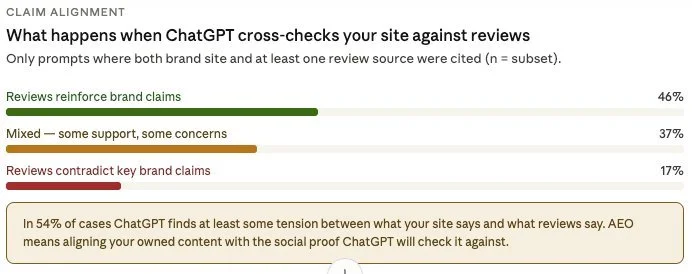
Outcome breakdown when ChatGPT cited both the brand’s own site and at least one external review source.
| Outcome | Share of prompts |
|---|---|
| Reviews reinforce brand claims | 46% |
| Mixed: some reinforcement, some concerns | 37% |
| Reviews contradict key brand claims | 17% |
In 54% of cases, ChatGPT found at least some tension between what the brand said and what reviewers said.
Your site and your reviews are not two separate things in AI search. They get read together. When they conflict, ChatGPT weighs the volume and consistency of external signals. A single owned source does not win that comparison.
Review management is part of your content strategy now. Not later. Now.
In more than half of cross-reference cases, the brand story and the review story did not fully match. That gap is where AI search makes its judgment call.
This Is Not a Permanent State. Models Change.
The citation numbers you are seeing right now are real. They are also tied to a specific model version. Here is what the trend looks like and why building for credibility matters more than chasing the current numbers.
The 50% brand-site citation share on brand-direct prompts is real. It is also specific to GPT-5.4. Earlier models looked very different.
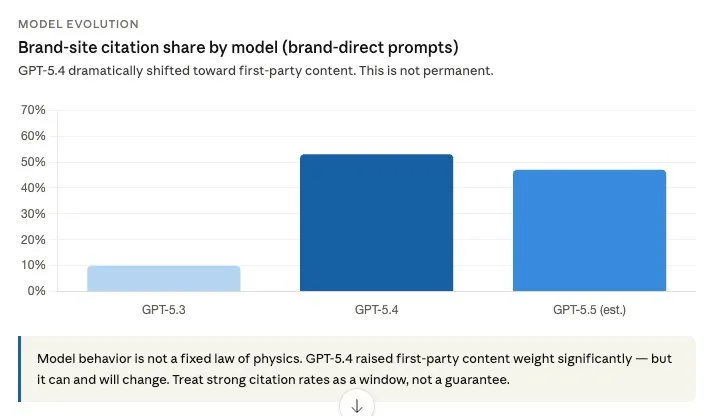
Brand-site citation share on brand-direct prompts across GPT model versions.
| Model | Brand-direct: % of citations to brand site |
|---|---|
| GPT-5.3 | 8–12% |
| GPT-5.4 | ~50–57% |
| GPT-5.5 (estimated) | ~45–50% |
GPT-5.3 cited brand sites in 8 to 12% of cases. GPT-5.4 jumped that to 50 to 57%.
GPT-5.5 estimates suggest it is already pulling back toward the middle.
That is not a reason to wait. It is a reason to build now, while the window is open, and build in a way that holds regardless of what the next version does.
GPT-5.4 opened a real window for owned content. GPT-5.5 is already narrowing it. Build for credibility, not just for the current citation rate.
Open-Ended Queries Are Where Most Buyers Start
Branded search is where most AEO attention goes. But the buying journey typically starts well before a buyer knows your name. That earlier stage is where the visibility gap is widest.
Most AEO work focuses on branded queries. Your company name. Your product. Your name versus a competitor.
That work matters. But it is not where the buying decision usually begins.
Buyers start with questions like: “What should I use for X?” “How do companies handle Y?” “What are my options for Z?” At that point, your site has a 22% citation share if it shows up at all. Reviews and forums are running the conversation.
The brands showing up in those answers have content that directly addresses category-level questions, not just product-level ones. And they have a presence on the external platforms that dominate open-ended citation patterns.
Owning the branded query is a floor. The open-ended query is the opportunity.
Most buyers do not start by searching your name. They start with a question. Show up there or let someone else shape the conversation first.
Key Takeaways
Takeaway 1: Your brand site has its highest influence at the second search call, the verification stage. Content that is thin or hard to extract loses the narrative at that moment, regardless of how it ranks in traditional search.
Takeaway 2: The open-ended query is where brand-site citation share drops from 50% to 22% and external sources take over. That is where most buying journeys start and where most AEO strategies are least developed.
Takeaway 3: Your website and your reviews are a single unit in AI search. In 54% of cross-reference cases, ChatGPT finds some tension between the two. Closing that gap is as important as optimizing the content itself.
Actions
Action 1: Audit your reviews against your site’s claims
Pull your top 10 claims from your homepage and product pages. Search those themes in your G2, Trustpilot, or Capterra reviews. Where the two conflict, you have a cross-reference problem that will show up in AI search answers. Fix it by updating the claim, or by running a review generation campaign to build external support for it.
Action 2: Build answer pages for open-ended category queries
Write down the five to ten questions a buyer asks before they know your name. Build a dedicated page for each one. Lead with a direct answer in the first two sentences, then support it. These are not blog posts. They are structured answer pages built to be extracted by an AI in a single pass.
Action 3: Find out where you stand right now
Run your top five branded queries and top five open-ended category queries through ChatGPT, Perplexity, and Google AI Overviews. Note who gets cited, what claims surface, and where your brand does or does not appear.
You can also run your domain through the Camino5 visibility tool at tools.camino5.com for a faster read.
Action 4: Reformat your top pages to lead with answers
Go through your top 20 pages. Check whether each one answers a specific question in the first two sentences or just covers a topic. AI search extracts from content that answers first and explains second. Reframing the opening of each page is a structural fix that does not require writing anything new.
Action 5: Treat earned media as AEO infrastructure
Media and publisher content accounts for 42% of first-call fetches in ChatGPT’s discovery stage. That coverage shapes how the model frames your category before it reaches your site. Trade publication mentions, analyst coverage, and earned press are part of your AEO foundation.
Camino5 helps founders and marketing leaders build the kind of presence that shows up in both search and AI. See where your brand stands right now at tools.camino5.com.
Credibility is only visible if you can see what AI is actually saying about you. Run your free Invisibility Score to see the real responses from ChatGPT, Claude, Perplexity, and Gemini — and where your brand stands against your top competitor. About 30 seconds, delivered by email.