
Meta's AI Revolution Isn't About AI, It's About You: 3 Human Skills to Master Now
If it feels like the ground keeps shifting beneath your feet with Meta Ads, you are not imagining it. What we are living through is not a minor update or another quiet algorithm adjustment. It is a foundational transition into what is becoming the new AI Era of advertising.
The counterintuitive truth is that as artificial intelligence automates more of the technical mechanics that once defined media buying, the real competitive edge is becoming more human than ever. The advantage is no longer about mastering the machine. It is about mastering the parts of the craft the machine cannot touch.
Below, we look at the three human skills that will define who wins in this evolving landscape.
A Quick History: How We Arrived in the AI Era
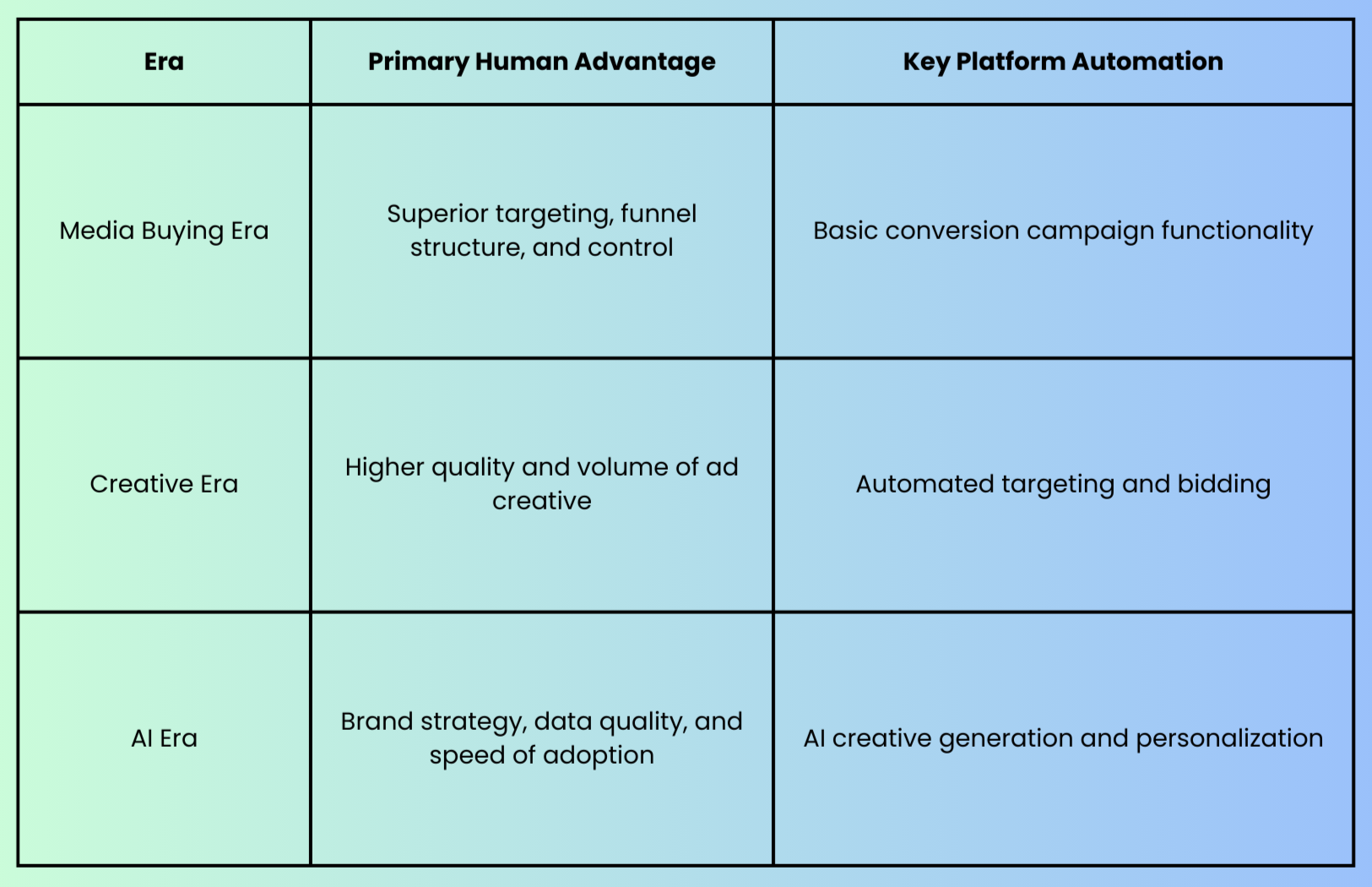
To understand where we are going, it helps to see the path behind us. Modern Meta advertising has moved through three distinct eras.
The Media Buying Era
For the first five or six years, technical mastery created winners. Sophisticated targeting, intricate funnel structures, and tight control over placements were enough to outperform competitors. Basic creative was often sufficient if your media buying was sharp.
The Creative Era
As Meta automated targeting and bidding, the technical playing field flattened. Creative became the primary differentiator. The right hook or the right video could flip a campaign from loss to profit. Creative testing became the heartbeat of performance.
The AI Era (Today)
We are now entering a period where AI is raising the baseline quality and volume of creative available to everyone. Automation is repeating its familiar pattern. As the platform handles more execution, the human advantage rises to a higher level of strategy, relevance, and meaning.
Here is the pattern summarized.
Strategy 1: Build a Brand That Cuts Through the AI Noise
As AI-generated content floods the feed, consumers will lean harder on trusted brands to filter the noise. When everything begins to look and feel the same, people reach for a signal they can trust. Your brand becomes that signal.
This creates an interesting split in the market. On one side, consolidation. Overwhelmed by AI content, people will default to the large brands they already trust. On the other side, proliferation. AI will enable a rise of ultra-niche businesses built for highly specific customers in the long tail. Success requires choosing one of two paths. Become a clear authority or dominate a narrow niche.
One of the most effective ways to build trust is through creators and influencers. They offer three human advantages.
Scroll stopping ability. A familiar face interrupts the pattern of the feed.
Holding ability. People willingly watch those they already like.
Transfer of trust. Their recommendation carries weight. When they say “I use this and it works,” the audience leans in.
Creator ecosystems will expand. We will see human creators, AI creators, and hybrid models. All will hold value because anyone who builds real attention will hold influence.
Strategy 2: Master Your Data. It Powers the AI You Rely On
An AI is only as strong as the data it receives. As Meta’s AI becomes central to performance, advertisers are not simply optimizing campaigns. They are building tomorrow’s data infrastructure. Clean, consistent, accurate data becomes the new strategic edge.
You do not need a data scientist to win. The fundamentals matter most, and most advertisers do not execute them well. Two essential steps are within reach for anyone.
Install the Conversions API (CAPI) correctly.
Improve event match quality using Meta’s recommendations.
This creates an opportunity for detail-oriented advertisers. If you supply higher-quality data than your competitors, Meta’s AI rewards you with better performance, better prediction, and better outcomes.
Strategy 3: Weaponize Your Speed and Agility
The pace of change on Meta is accelerating. Speed is now a strategic advantage.
New features and placements appear constantly. Early adopters see lower CPMs and outsized returns before the rest of the market catches up. When ads expand into new environments like WhatsApp, the first advertisers there get the benefit of low demand and high attention.
Small and nimble businesses have an edge. Large organizations move slowly due to internal approvals and bureaucracy. The ability to test, learn, and implement within days, not months, becomes a uniquely human advantage that AI cannot replicate.
The Next Frontier: Selling to AI Agents
A fascinating shift is emerging. Soon, advertisers will not only market to people. They will market to people’s AI agents.
These personal agents will understand their owners with remarkable precision. They will be tasked with finding products and services that match specific needs.
Imagine a niche product like a dog walking jacket for a man who is 5 feet 9 inches with longer than average arms, who needs pockets for bags, a whistle, a waterproof ball pocket, and a design subtle enough for a restaurant. Historically, the market for this was too small to reach efficiently. But an AI agent can find it instantly.
This unlocks a massive opportunity. Ultra-niche products become commercially viable. Small entrepreneurs can serve micro-segments that large incumbents cannot reach.
This aligns naturally with Meta’s direction. The Andromeda update introduces a more advanced retrieval system designed for personalized delivery. It is built to match niche products with niche buyers or their AI agents.
The Advertiser of the Future is a Strategist, Not a Technician
The AI Era is not replacing advertisers. It is elevating them.
As AI takes over technical execution, the advantage shifts to those who can create meaning, trust, precision, and speed. The winners will be the strategists who build trusted brands, provide AI with exceptional data, and move faster than the rest of the field.
If AI is taking over the how, the real question becomes:
How will you redefine your who and why to build a brand that truly connects?
Ryan Edwards, CAMINO5 | Co-Founder
Ryan Edwards is the Co-Founder and Head of Strategy at CAMINO5, a consultancy focused on digital strategy and consumer journey design. With over 25 years of experience across brand, tech, and marketing innovation, he’s led initiatives for Fortune 500s including Oracle, NBCUniversal, Sony, Disney, and Kaiser Permanente.
Ryan’s work spans brand repositioning, AI-integrated workflows, and full-funnel strategy. He helps companies cut through complexity, regain clarity, and build for what’s next.
Connect on LinkedIn: ryanedwards2