
The Three Eras of Meta Advertising: A History for Marketers

Understanding the Evolution of Meta Ads
A quiet shift is happening inside Meta’s ecosystem, and it is larger than an algorithm change. We are watching a structural transition that will reshape how brands show up, get discovered, and earn trust.
What originally seemed like a story about media buying has become a story about creative. And now, it is becoming something even broader. AI is not just changing how ads run on Meta. It is changing how brands appear in AI search, large language models, and the next generation of discovery tools. Half of consumers already use AI powered search, and it is projected to influence roughly 750 billion dollars in revenue by 2028. In this world, you can run strong Meta ads and still be invisible in an AI answer, which is quickly becoming a new first impression channel.
Understanding how competitive advantage shifts on Meta helps you see where advantage is shifting everywhere else too. That is why these three eras matter.
The Media Buying Era: Winning Through Technical Skill
What It Was
For the first five or six years, Meta advertising favored those who understood the technical machinery. Success came from how well you built the backend, not the creative.
How Advertisers Won
Those who mastered the platform’s hidden levers carried a real advantage.
Stronger targeting setups.
Multi step funnels that guided users toward conversion.
Precise control over placements and campaign settings.
Even simple creative could work if the technical structure behind it outperformed everyone else.
Why This Era Ended
Meta automated much of the technical work. Targeting. Bidding. Delivery. Optimization. These shifts flattened the differences between skilled buyers and everyone else.
Once the machine handled execution, human advantage migrated somewhere else. The story inside the ad became the new battlefield.
The Creative Era: Winning Through Compelling Content
What It Was
When media buying was automated, creative became the clearest path to differentiation. Your ability to capture attention, hold it, and persuade became the core driver of performance.
How Advertisers Won
This era rewarded those who treated creative as a discipline.
Higher investment in thoughtful production.
Strong hooks and fast hold times.
Systematic split testing to find the version that actually moved people.
The right creative could flip a losing campaign into a profitable one.
Why This Era Is Changing
AI tools are lifting the baseline quality of creative for everyone. Small businesses with limited budgets can now generate higher volume, higher quality content. As the floor rises, creative still matters, but it becomes less of a stand alone advantage.
Something else is beginning to matter more.
The AI Era: Winning Through Brand, Data, Speed, and Visibility in AI
We are now entering the early stages of the AI Era, where Meta is not the only discovery engine shaping outcomes. LLMs, AI search, and AI recommendation systems are becoming new places where brands are discovered and compared.
This shift introduces three new strategic levers.
1. Build a Strong Brand That Shows Up Everywhere Users Search
In an AI saturated environment, brand becomes a filter for trust. People rely on recognizable names to cut through noise from AI generated content.
And there is now concrete evidence that how your brand shows up in AI systems is becoming a measurable source of competitive advantage.
Brands in the top quarter for web mentions receive roughly ten times more visibility in AI generated answer panels.
The top 50 authority brands capture almost 29 percent of all AI Overview mentions.
A quarter of brands studied had zero visibility in AI Overviews, even when they ranked in traditional search.
This is the new version of Page One.
Creators play an important role here too. They are pattern interrupters. They are trust carriers. Their recommendations influence both humans and the user generated content that AI systems later rely on. Even Reddit and community conversations now shape how LLMs describe products, strengths, weaknesses, and reputation.
One case study demonstrates this clearly. A brand used structured community engagement on Reddit to lift sentiment, which later increased the brand’s appearance rate in AI answers. Better conversation feeds better AI.
Looking ahead, creators will not only be human. AI generated creators and hybrid identities will carry real influence. If they can build a loyal following, they can move a market.
This opens the door to a second frontier: selling to AI agents. As AI assistants learn user preferences, they will find hyper specific products for them. Meta’s Andromeda update is moving in this direction with more personalized retrieval. The smallest brands can win here because AI can surface ultra niche products that would have been impossible to market two years ago.
2. Ensure High Quality Data. AI Feeds on Precision
Meta’s AI performs based on the data you provide. But this is not just a Meta issue. It also shapes whether AI systems in general can confidently reference your brand.
Across multiple studies:
Structured data, clear pricing, and strong third party validation directly increase whether brands appear in AI search results.
Traditional backlink metrics correlate far less with AI visibility than brand strength metrics such as branded mentions, branded anchors, and search volume.
Being cited by AI systems depends heavily on whether the model can find evidence of real commercial activity, sometimes called proof of commerce.
One case study illustrates the opportunity. A small B2B SaaS company began with only 5 percent visibility across 50 high intent AI prompts. After six months of targeted LLM optimization, they reached 90 percent visibility and attributed more than 115 thousand dollars in revenue to the effort. Their cost was in the low thousands.
The lesson is simple. You can out improve larger competitors if your data is cleaner, clearer, and more connected.
For Meta specifically, this means:
Installing the Conversions API correctly.
Improving event match quality.
Following Meta’s structured data recommendations.
These basics sound simple, yet most advertisers do not execute them well. In an AI driven environment, superior data becomes a strategic advantage on every platform that relies on AI to generate answers.
3. Move With Speed. The Advantage Compounds
The pace of change on Meta is accelerating. So is the pace of change in AI search.
Early adopters pick up disproportionate value.
When Meta opens new placements like WhatsApp, demand is low and CPMs are cheap. When AI systems shift the signals they trust, the first brands to adjust gain visibility before competitors catch on.
This is where smaller businesses hold a natural edge. They are not slowed down by long approval cycles. They can test ideas quickly. They can respond to new opportunities in days rather than quarters.
In the AI Era, speed is not just an operational benefit. It is a compounding strategic one.
Your Path Forward
The evolution of Meta advertising mirrors the evolution of digital discovery as a whole. Human advantage moves to whatever the platform has not automated yet.
Here is the landscape in one view.
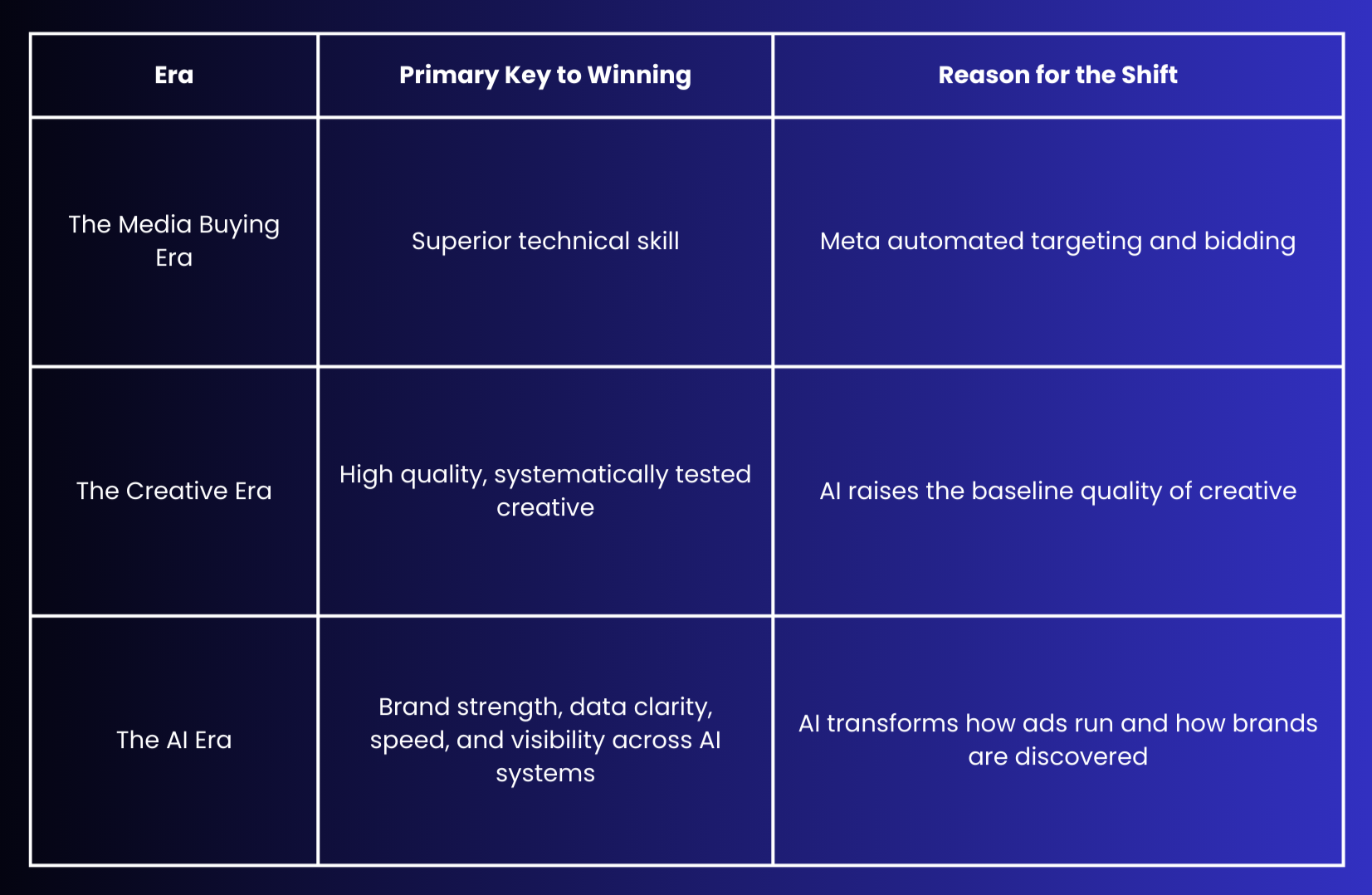
Tools will change. Platforms will evolve. Algorithms will shift. The constant is the need to show up clearly, consistently, and credibly wherever your audience discovers new information.
Understanding the history of how competitive advantage is earned on Meta helps you see the broader trend. The brands that win in the AI Era are the ones that are easy for both people and AI systems to recognize, trust, and recommend.
How to Operationalize the AI Era Framework
Understanding the three eras gives you context. Turning that context into a competitive advantage requires a simple, repeatable operating system. Below is a guide you can use to move from insight to implementation in a way that feels structured, calm, and grounded.
This is the practical version of everything the article has been pointing toward.
The AI Era Operating Framework
A Four Phase System for Visibility, Performance, and Long-Term Advantage**
Phase 1: Assessment
Understand how you are seen by both people and AI systems**
The goal is clarity. Most brands assume they are visible in AI search and AI generated answers. Many are not. Start with a baseline.
What to do:
Define 25 to 50 high intent prompts your buyers actually use.
Run them across ChatGPT, Claude, Gemini, Perplexity, and Google AI Overviews.
Log where your brand appears, how it is described, and which competitors show up more often.
Evaluate whether reference points come from your site, user reviews, news sources, Reddit, or third party content.
Why it matters:
Half of consumers now use AI powered search and industry analysis shows that top brands receive ten times more visibility in AI results because they consistently show up across the web. In some studies, one quarter of brands had zero presence at all.
Assessment turns that risk into a measurable, solvable problem.
Phase 2: Gap Mapping
Identify what is missing, unclear, or outdated about your brand signals**
This is where you start to see the root causes of invisibility or underperformance. AI systems rely on structured data, consistent narrative signals, and a clear record of real commercial activity.
What to do:
Audit your structured data and entity definitions.
Check whether pricing, product details, and brand descriptions are clear, consistent, and verifiable.
Identify outdated or incomplete information that might mislead AI systems.
Evaluate whether user generated content, reviews, or forums support or harm your narrative.
Why it matters:
AI models over index on high trust content from communities, reviews, and widely referenced sources. If those places are sparse, outdated, or incorrect, your AI visibility suffers. This phase helps you see the difference between what you think your brand communicates and what the internet actually says.
Phase 3: Content and Entity Strategy
Create the signals AI systems and human buyers use to understand your brand**
Once you know the gaps, you can begin building the specific assets, pages, and content types that strengthen your presence.
What to do:
Publish clear, structured product and service pages.
Add explicit entity definitions that link your brand to your category, your offers, and your commercial outcomes.
Strengthen authority signals by earning mentions from trusted third party sources.
Encourage user generated content and community conversation that AI systems later use as training inputs.
Support creators who can lift both human trust and AI recognition.
Produce content that answers your priority prompts clearly and directly.
Why it matters:
Case studies show brands moving from 5 percent to 90 percent visibility in six months by clarifying these signals. The result was more than 400 percent growth in AI driven traffic and six figure revenue impact from a modest investment.
This is where brand, content, and data converge.
Phase 4: Monitoring and Iteration
Treat AI visibility like a recurring program, not a one time audit**
The landscape shifts quickly. AI systems update their sources, tune retrieval layers, and adjust weighting for structured data and brand signals. Your visibility can improve or decline without warning.
What to do:
Re run your prompt list quarterly.
Track changes in mentions, sentiment, and competitor visibility.
Review how creators, Reddit threads, reviews, and news stories evolve over time.
Update structured data, schema, pricing, and product details as your business changes.
Expand your prompt list as category trends shift.
Why it matters:
Brands that treat this as a continuous program outperform those who see it as a one time check. The compounding nature of early visibility means you benefit from every iteration while competitors fall further behind.
Putting It All Together
Month 1
Assessment and Gap Mapping
Build your prompts. Audit your signals.
Months 2 to 3
Content and Entity Fixes
Strengthen data quality, brand clarity, authority signals, and creator presence.
Month 4
Re measurement and refinement
Adjust your strategy based on the new baseline.
Ongoing (Quarterly)
Monitoring
Track your visibility like a real metric. It is one now.
Ryan Edwards, CAMINO5 | Co-Founder
Ryan Edwards is the Co-Founder and Head of Strategy at CAMINO5, a consultancy focused on digital strategy and consumer journey design. With over 25 years of experience across brand, tech, and marketing innovation, he’s led initiatives for Fortune 500s including Oracle, NBCUniversal, Sony, Disney, and Kaiser Permanente.
Ryan’s work spans brand repositioning, AI-integrated workflows, and full-funnel strategy. He helps companies cut through complexity, regain clarity, and build for what’s next.
Connect on LinkedIn: ryanedwards2