
Trust Is Now a Performance Variable: How E-E-A-T Reshapes Paid Search and Social

Quick Facts:
93% of buyers say reviews influence decisions.
2.5x trust beats a stronger discount in paid ads.
43% CPC reduction from better landing pages.
Trust is now a performance variable
Google's E-E-A-T framework was built for organic search. But the trust signals it measures have migrated into every paid channel you're running. This article examines what that shift means for your campaigns, where the data is clear, where it needs nuance, and what you can do about it without rebuilding your entire marketing stack.
The problem: your ads are bidding against themselves
You've seen it. Cost-per-click climbing. Quality Scores softening. Conversion rates holding flat despite more spend and sharper creative. You run the numbers, check the targeting, tweak the bidding strategy. Nothing moves.
Here's the diagnosis most performance teams miss: the issue isn't the ad. It's the credibility gap between the ad and everything that follows it.
Consider what your campaigns are actually running against. The modern buyer, whether a CMO evaluating a SaaS vendor or a consumer deciding between two skincare brands, arrives at your landing page having already formed a trust framework. They're looking for evidence, not promises. And most paid campaigns are still built to promise.
reviews influence
purchase decisions
reviews present
much as personal
recommendations
likely to purchase after a
peer review
That is not niche behavior. That is the market your paid spend is operating inside every single day. And yet most campaigns treat trust signals as decoration: reviews added to a landing page as an afterthought, testimonials buried on a separate page that paid clicks never reach, ad copy that promises expertise and a landing page that delivers generic category prose with no author, no proof, and no reason to believe.
That gap is a performance problem. It shows up in your conversion rate, your Quality Score, and your cost-per-click. It just doesn't arrive labeled as a trust deficit. So it gets misattributed to creative fatigue or audience targeting, the fix never addresses the actual cause, and the gap compounds.
SEO and performance have always had a symbiotic relationship
SEO and paid performance have always shared a quiet dependency. Strong organic presence lowers branded CPC. High-quality landing pages built for search also convert paid traffic better. A domain that ranks well for a category query carries implicit credibility when that same brand appears in a paid slot. The channels have always been in conversation.
But the relationship has never been as direct or as consequential as it is now. The reason is AI. Contextual targeting, audience matching, and relevance scoring across Google, Meta, and LinkedIn are increasingly driven by machine learning systems that evaluate signals the same way a quality rater would: is this source credible, consistent, and authoritative in its domain? SEO, and now AEO, the optimization for how AI systems retrieve and cite content, feeds those signals directly. Your domain's trust posture is no longer just an organic ranking input. It is a performance targeting input.
Trust versus authenticity: the distinction that actually matters
Here is where most brands conflate two things that are genuinely different. Authenticity has become the word the industry reaches for, and it is not wrong exactly, but it points to the wrong priority.
Authenticity is a function of tone and point of view. It is the voice your brand uses, the perspective it brings, the consistency of personality across touchpoints. You can be deeply authentic, honest, specific, and human, and still be invisible. Authenticity without trust has no distribution.
Trust is a function of domain authority, consistency, and velocity. It is built through the accumulation of signals over time: who links to you, who cites you, how consistently your content delivers on what it promises, how long your domain has been a reliable presence in its category. Trust is what gives authenticity reach.
The practical implication for paid campaigns is direct. Google's Quality Score has three components: expected click-through rate, ad relevance, and landing page experience. That third factor accounts for roughly one-third of the total weighting. It evaluates relevance, transparency, and ease of navigation, all downstream expressions of trust. Platforms do not just evaluate whether your ad matches the query. They evaluate whether the brand behind it can be trusted to deliver what the ad implies.
improvements
Google's E-E-A-T framework, which stands for Experience, Expertise, Authoritativeness, and Trustworthiness, sits formally in its organic Search Quality Rater Guidelines. Google never says E-E-A-T is a paid ranking factor. But the traits it describes, credentialed authors, verifiable claims, transparent sourcing, consistent domain authority, map almost exactly to what its systems reward in landing page evaluations. The terminology differs. The underlying logic is the same. And now that AI contextual targeting reads those same signals to decide whose ads are most relevant, the overlap has become near-total.
The insights: what the data actually shows
The trust premium in ad creative
The clearest evidence that trust content changes paid performance comes from ad-level testing, not just landing page optimization. A 2026 study conducted by Trustpilot and London Research tested what happens when you add credible social proof directly into ad creative. The findings were striking enough to reframe how you should think about the creative brief.
Ads with a 5-star Trustpilot rating and 500+ reviews were 3.5x more compelling than identical ads with no review content
Ads featuring 3,000+ reviews improved performance by 33% over the same ad with no review count shown
Trustpilot-badged ads generated 57% higher CTR than identical ads using Google Reviews
Ads with no review badge saw 5 to 10x lower CTR than those with review content
Ad effectiveness multiplier · Source: Trustpilot / London Research, 2026
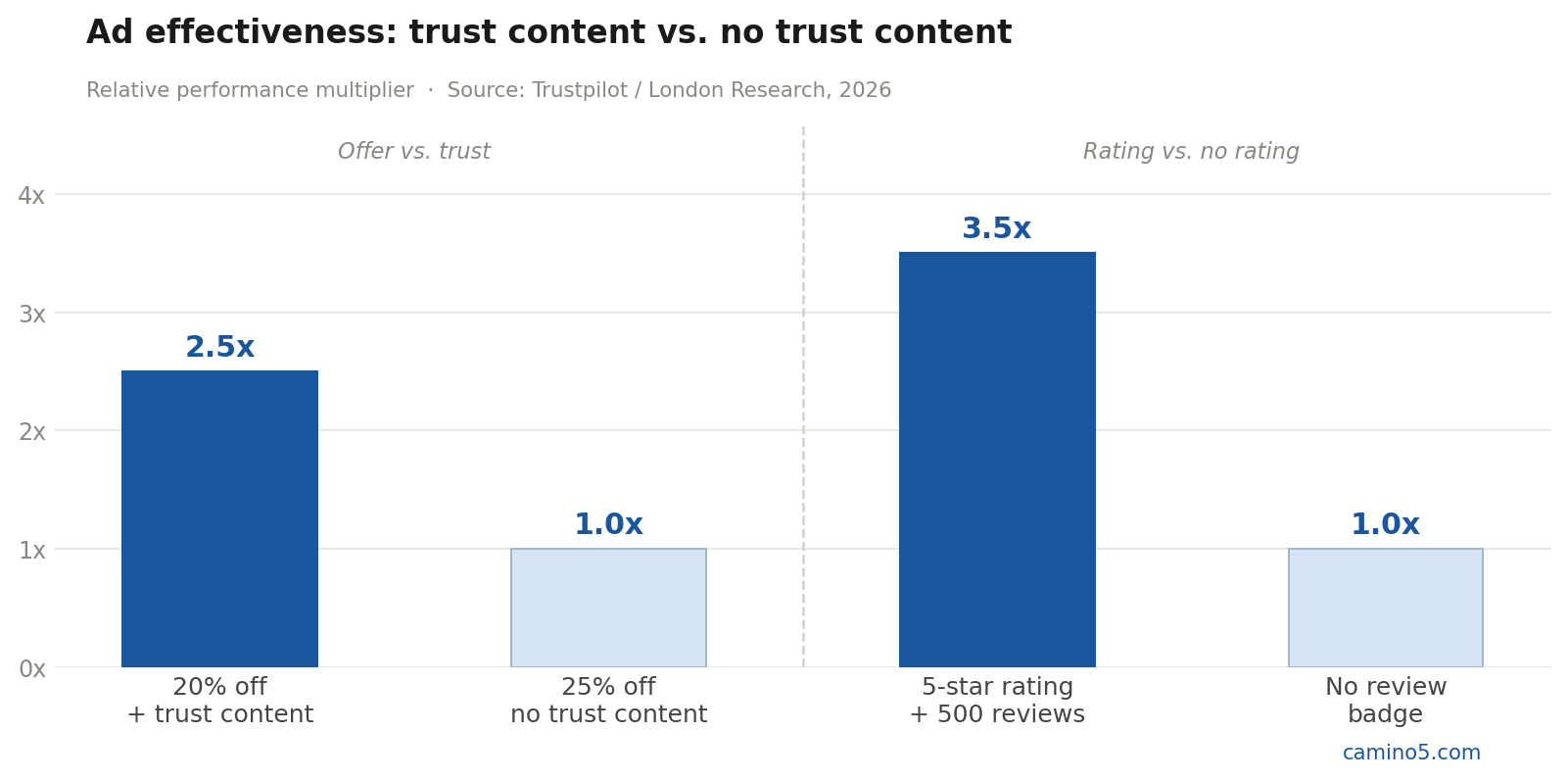
The practical implication is direct. Trust content in the ad itself, not just on the landing page, is a performance variable. Most teams optimize the offer and the creative. Few treat credibility signals as a creative element worth testing with the same discipline they apply to headlines and images.
Why landing page trust is a paid media cost driver
The conversion math on landing page credibility is well-established. These are not soft signals. They are measurable, testable levers with large effect sizes in controlled studies.
Adding product reviews to a page can increase conversions by up to 270%
Adding just three customer testimonials lifts conversion rates by 34%
Real-time social proof notifications, showing recent purchases or views, can boost conversions by approximately 98% versus static pages
These numbers vary by category and context. Not every test produces lifts at that scale. But the directional evidence is consistent: pages with verifiable social proof convert better than pages without it, and the gap is large enough to show up in paid campaign ROAS even before any changes to bid strategy or audience targeting.
This is where the E-E-A-T lens becomes practically useful. Pages that demonstrate real expertise, show named authors, feature customer evidence, and make clear who is behind the brand satisfy both the platform's quality evaluation and the consumer's trust threshold simultaneously. You are not optimizing one page for SEO and a different page for paid. The same improvements serve both, which means the ROI on building credible destinations compounds across every channel.
The B2B trust stack
B2B performance marketing operates under a specific constraint: decision-makers are skeptical by profession. They evaluate vendors for a living. An ad that implies authority without delivering evidence doesn't just fail to convert. It actively signals to the buyer that this brand isn't ready for serious consideration. The sales cycle extends. The evaluation moves to a competitor. And none of that shows up in your campaign reporting.
peer review
LinkedIn's algorithm has made the credibility dynamic more measurable. The platform's 2025-2026 direction shifted explicitly toward personal expertise over company page reach:
Carousels and PDFs from named individuals perform 1.9x better than text-only posts from company pages
Comments over 15 words increase post reach by up to 2.5x
Sponsored content from identifiable subject-matter experts generates stronger engagement than anonymous brand accounts
Third-party validation amplifies this. G2 and Capterra ratings in LinkedIn ad copy, client logos on landing pages, case studies with named clients and specific outcomes: these are not aesthetic choices. They are the evidence layer that moves a careful B2B buyer from interested to engaged. The buyer who clicks your paid search ad for enterprise data infrastructure has already read three competitors' content before reaching you. Your landing page does not need to restate the ad. It needs to close the trust gap that exists at the moment of arrival.
The D2C credibility problem
In direct-to-consumer paid marketing, the trust evaluation happens faster. Buyers don't spend weeks assessing your brand. They spend seconds. But the underlying question is identical: is this brand what it says it is? And the consequences of getting it wrong are equally real, they just play out at checkout instead of in a sales cycle.
recommendations
advertising
have purchased
The April 2026 Google core update made the cost of this credibility gap visible at scale. Sites that depended on generic, credential-free content saw dramatic traffic losses. Aranzulla.it fell from 19 million to 11 million monthly visits. Ilmeteo.it lost 16 million visits in the same cycle. What these sites had in common was factual, commodity content with no first-hand experiential layer: no named authors, no verifiable expertise, no authentic human signal.
The same vulnerability that collapsed their organic traffic is identical to what limits paid conversion performance. It is the absence of proof. For D2C paid social specifically, the evidence points clearly toward authentic, experience-driven creative outperforming polished brand production in cost-per-acquisition benchmarks. Ads featuring behind-the-scenes content, user-generated creative, and real customer stories consistently outperform traditional campaign assets. This is not about lowering production values. It is about the signal that authentic content sends: this brand is real, these customers are real, and the experience they describe is real.
The nuance worth stating directly
E-E-A-T is a useful framework for diagnosing the trust gap, but it can lead you to over-index on brand expertise and under-invest in peer credibility. Those are not the same thing, and confusing them is a real strategic error.
This means the E-E-A-T improvements that matter most for paid performance are not about demonstrating how accomplished your brand is. They are about making visible the evidence that real people have engaged with your product and found value in it. Author bios on landing pages matter. Named case study clients matter. Review volume and recency matter. G2 scores in LinkedIn ads matter. The credibility signals that move buyers consistently come from outside the brand's own claims.
E-E-A-T is the right lens to identify the gap. Peer evidence is usually the right tool to close it.