
The Three Pillars of AEO & SEO Success

The Great Disruption
The digital landscape is undergoing a fundamental shift from keyword-driven discovery to conversation-driven discovery. In traditional search, people search for links; in AI search, people engage in a dialogue with models like ChatGPT, Perplexity, and Google’s AI Overviews to receive direct, compiled answers.
This shift shatters the traditional "clickstream." When an AI provides a complete answer, the need for people to visit a website diminishes. While the website may be the creator of the information, it no longer is the distribution channel. This doesn't mean the marketing opportunity has disappeared, it means it has expanded to include the AI's response.
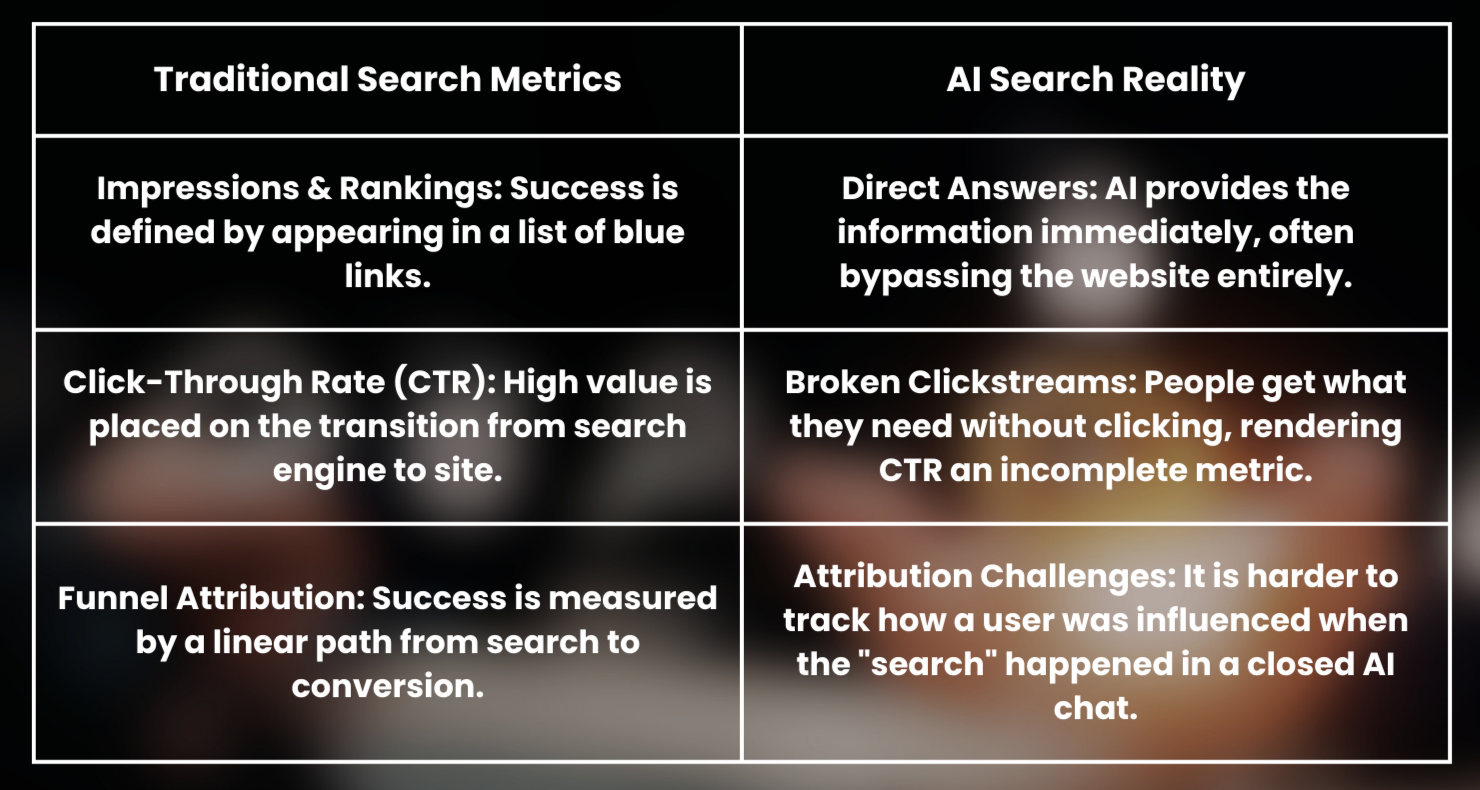
A marketer can no longer rely on a click to measure brand health. If an AI tool recommends your brand but the user never visits your site, traditional metrics record a "zero." In reality, your brand just won the "mental shelf space" of the consumer. Success now requires measuring influence within the AI response itself.
Because the landscape has changed, we need a new way to measure success that accounts for these "zero-click" influences.
The Three Pillars of AI Success
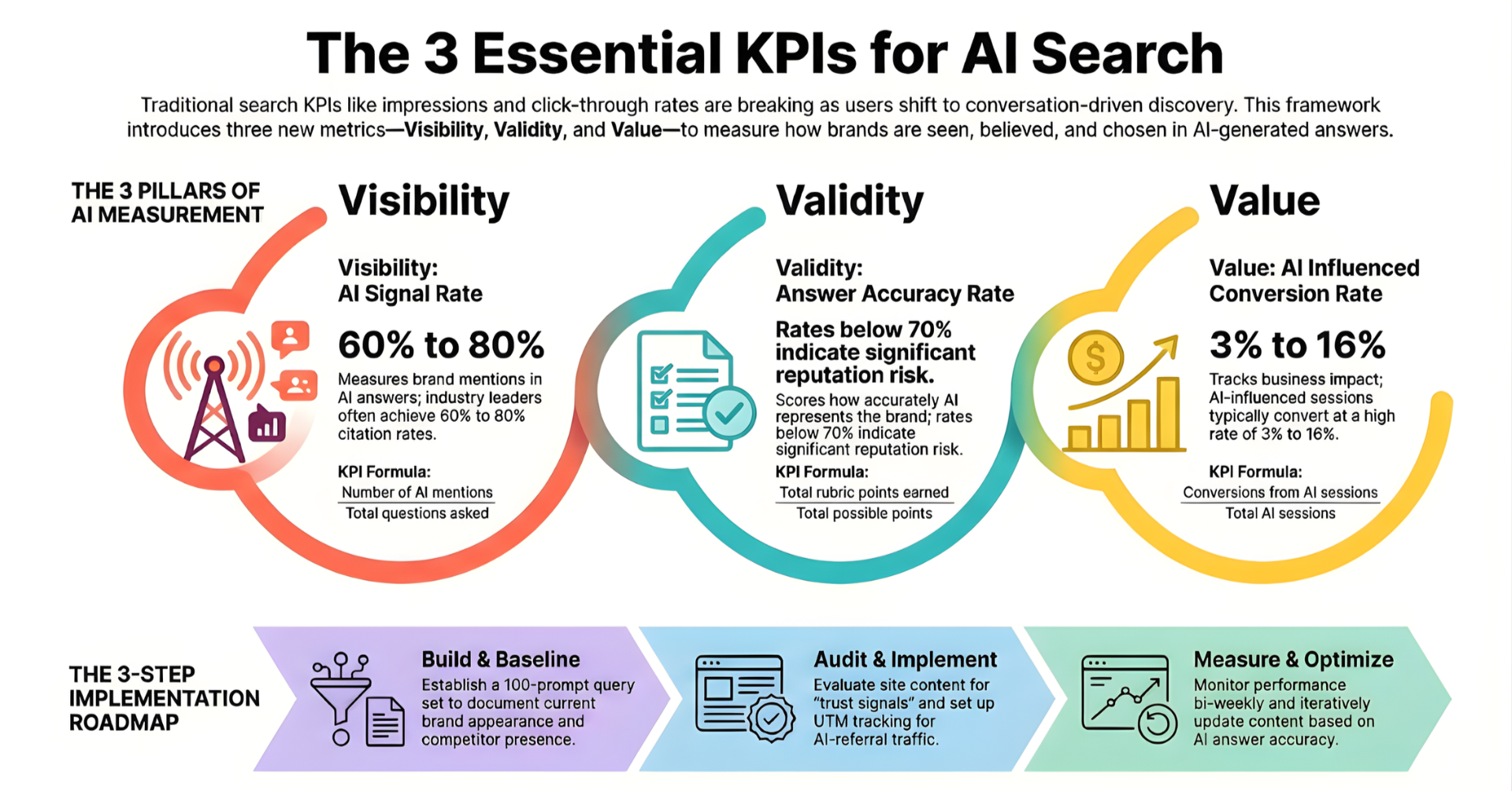
To master this new era, we utilize the "Visibility, Validity, Value" framework. This model allows brands to track the entire AI-driven customer journey from initial discovery to the final decision.
Visibility (AI Signal Rate): Measuring your presence and share of voice within AI-generated answers.
Plain Language: Are we even showing up when people ask AI about our product category?
Validity (Answer Accuracy Rate): Measuring the quality, truthfulness, and reputation of the mention.
Plain Language: Is the AI telling the truth about our brand, or is it hallucinating?
Value (AI Influenced Conversion Rate): Measuring the tangible business impact of AI discovery.
Plain Language: Are these AI-driven interactions actually resulting in sales or leads?
"If search behavior changes, marketing measurement must follow."
Connective Tissue: Transitioning from theory to practice, we begin with the first requirement for any brand: ensuring you are visible to the machine.
Pillar 1: Visibility (The AI Signal Rate)
The AI Signal Rate (historically referred to by Seer Interactive as the Seer Signals score) measures your brand's "Share of Voice" within AI-generated answers.
The Formula: AI Mention Rate = (Number of AI answers that mention your brand) / (Total AI questions asked)
Why it Matters: Visibility is the baseline of discovery. If AI tools are not mentioning your brand when people ask for recommendations (e.g., "What are the best gifts for the holidays?"), your brand is effectively invisible to that consumer.
What Good Looks Like:
Market Leaders: Typically achieve citation rates between 60% and 80%.
Challenger Brands: Often start much lower, between 5% and 10%.
The Insight: This metric represents an evolution from "ranking #1" to "being part of the conversation." In an LLM-driven world, you aren't fighting for a spot on a list; you are fighting to be an essential part of the AI's helpful response.
Connective Tissue: While Visibility is the start, Visibility for the wrong things is a significant risk to your reputation.
Pillar 2: Validity (Answer Accuracy Rate)
To have validity, a brand must manage its "Brand Canon."
Definition: A Brand Canon is your official "source of truth"—mission statements, core values, and factual product data—that acts as the benchmark for what AI systems should say about you.
In the "new age of reputation management," brands must ensure that AI systems aren't just mentioning them, but representing them accurately. We measure this using a 6-point Rubric Scoring System:
Factual Correctness (0-2 points): Is the information objectively true?
Alignment with Canon (0-2 points): Does the answer reflect the brand’s official messaging and values?
Hallucination Presence (0-2 points): Did the AI invent fake features or non-existent details?
Performance Thresholds:
Good (85%+): Indicates a strong, clear content foundation.
Risk (Below 70%): Consumers are likely receiving misinformation, which erodes trust.
Connective Tissue: Visibility and accuracy are prerequisites, but they are ultimately meaningless if they do not lead to a human decision.
Pillar 3: Value (AI Influenced Conversion Rate)
The AI Influenced Conversion Rate is the KPI the CFO cares about most because it links AI visibility directly to business impact.
Three Methods of Measurement:
Direct Tracking: Using custom "UTM" tags or Custom Channel Groupings in your analytics to identify traffic from AI platforms like ChatGPT, Gemini, or Perplexity.
Behavioral Inference: Identifying patterns like a spike in branded search volume following a major AI tool update or mention.
Post-conversion Surveys: Asking customers, "What led you here today?" to capture the AI's role in their journey.
Performance Benchmark: Data shows that AI-influenced sessions often convert at a rate of 3% to 16%.
The Insight: Why is this rate so high? Because by the time a user clicks through from an AI tool, they have already been "convinced" by the AI’s synthesis. The AI has done the heavy lifting of the sales cycle, meaning the traffic reaching your site is high-intent and pre-qualified.
Connective Tissue: Moving from understanding these concepts to measuring them at scale requires a more robust system than manual spot-checks.
Scaling Insights: The Agent-Assisted System
Measuring these KPIs across thousands of queries requires a hybrid system that combines AI efficiency with human precision:
Generate Prompts: Use a monitoring tool to execute branded and unbranded questions across various AI models.
Evaluate: An AI agent scores each answer based on your brand and value prop.
Score Confidence: The agent assigns a confidence score (0-100) to its own evaluation.
Set Thresholds: Establish a confidence threshold (initially 75%). Pro-tip: You may choose to lower this threshold during the setup phase to intentionally review more answers and "train" the model on your brand's nuances.
Escalate: Any evaluation falling below the threshold is sent to a human for manual review.
Train: Human corrections are fed back into the system, making the agent more accurate over time.
Why Scale Matters Manual spot checks are deceptive; a brand might look perfect in one search but fail in 500 others. A scalable, agent-assisted system provides measurement that is consistent, explainable, and high-quality, allowing you to track performance trends across the entire AI ecosystem (Gemini, Claude, Copilot, etc.).
Connective Tissue: With the measurement system in place, you are ready to implement the roadmap for your brand.
Your 6-Step Roadmap to AI Search Readiness
Use this checklist to establish your brand's presence in the AI era:
Step 1: Build Query Set – Create 100 prompts across comparison and problem-solving intents.
Pro-tip: Use an 80/20 split (80 unbranded/category questions and 20 branded questions).
Step 2: Establish Baseline – Run your prompts to see where you stand today.
Pro-tip: Document specific misattributions or instances where a competitor is mentioned instead of you.
Step 3: Audit Content – Ensure your website provides clear, structured information.
Pro-tip: Focus on entity accuracy and including "trust signals" (like certifications or expert bios) that AI models use to verify authority.
Step 4: Implement Tracking – Set up your analytics to identify AI-referral traffic.
Pro-tip: Create Custom Channel Groupings to separate AI traffic from traditional social or search traffic.
Step 5: Measure Consistently – AI models update their training data and behaviors frequently.
Pro-tip: Aim for bi-weekly measurement to catch sudden shifts in how AI tools describe your products.
Step 6: Optimize Iteratively – Use the data to refine your Brand Canon and site content.
Pro-tip: Follow the cycle: Measure, Learn, Improve, Repeat.
Early adoption is your greatest competitive advantage. By establishing your baseline now and measuring what matters, you ensure that your brand isn't just a part of the AI's answer—it's the answer the consumer chooses.
Ryan Edwards, CAMINO5 | Co-Founder
Ryan Edwards is the Co-Founder and Head of Strategy at CAMINO5, a consultancy focused on digital strategy and consumer journey design. With over 25 years of experience across brand, tech, and marketing innovation, he’s led initiatives for Fortune 500s including Oracle, NBCUniversal, Sony, Disney, and Kaiser Permanente.
Ryan’s work spans brand repositioning, AI-integrated workflows, and full-funnel strategy. He helps companies cut through complexity, regain clarity, and build for what’s next.
Connect on LinkedIn: ryanedwards2