
The Algorithmic Content Pivot

The Crisis of Consistency: Deconstructing AI Brand Recommendations
The digital ecosystem and consumer journeys are in the middle of a sharp transition. Traditional search engines are sharing the market with AI-driven recommendation systems and social., and for marketing leaders this shift is not merely a technical shift. It is a visibility problem.
Google search was built on relatively stable, indexable ranking factors. AI systems introduce a probabilistic layer that breaks those assumptions entirely. Traditional tracking models no longer hold.
Analysis drawn from nearly 10,000 combined runs across ChatGPT, Claude, and Google AI points to one clear conclusion: these systems are fundamentally inconsistent. The likelihood of an AI producing the same brand list, or even the same ranking order, across repeated queries is pretty unlikely.
The likelihood of AI producing an identical brand list or ranking order across repeated queries is negligible.
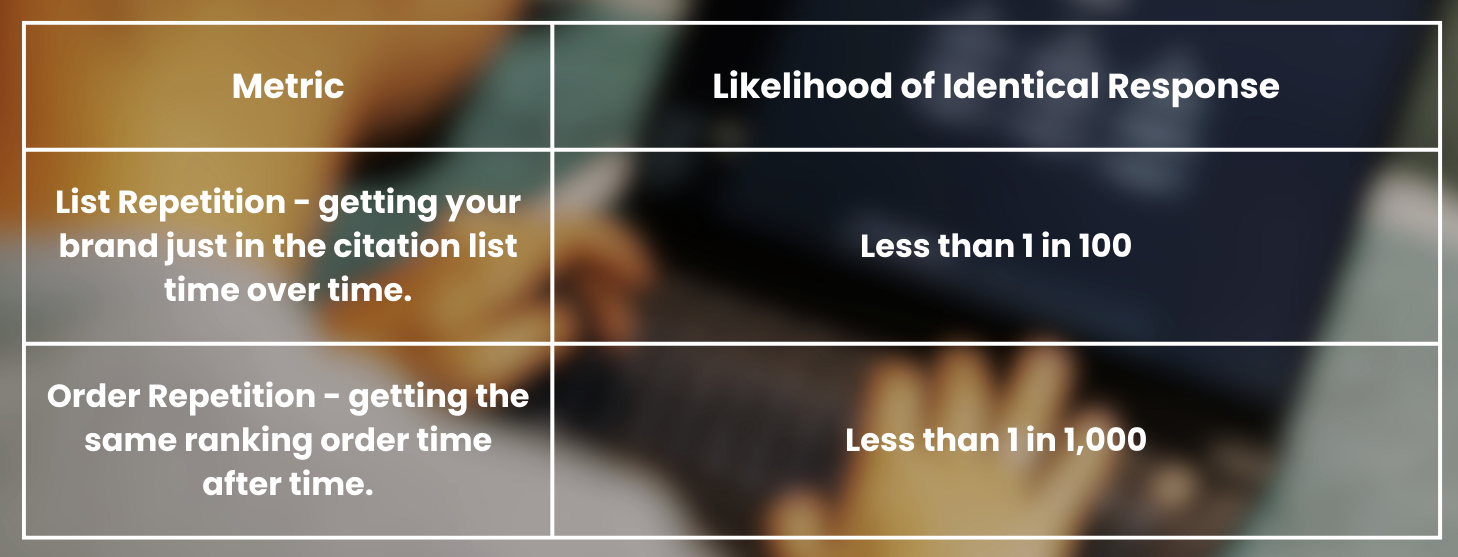
This volatility exists because AI models are not definitive databases of merit; they are "spicy autocomplete" engines.
They function by selecting tokens (words) based on their frequency within a training corpus or RAG (Retrieval-Augmented Generation) results. Brand placement in an AI response is a "statistical lottery" rather than a reflection of quality. Consequently, position-based KPIs are a legacy delusion; "ranking" in an AI era is a statistical fluke that provides zero predictive value for brand health. To find strategic ground truth, we must move from the volatility of individual responses toward aggregate visibility.
From Rankings to Reach: Validating the Visibility Percentage Metric
The strategic mandate has shifted from a "position-based" mindset to a "prominence-based" mindset within the environment AI forms its understanding from and the information AI learns from. In an era of randomized output, being "Number One" is a transient accident. The only defensible metrics are Visibility Percentage and Share Of Voice, the frequency with which a brand appears within an AI’s "consideration set" across a high volume of interactions and the over frequency you appear in the content ecosystem
Repeated prompting, typically 60 to 100 times, is needed to understand the patterns a model actually holds. How consistent the responses are depends largely on how much relevant information exists in the training data.
Narrow spaces: In categories with very few players, such as Volvo dealerships in Los Angeles, responses tend to be more consistent because the model has fewer options to choose from.
Wide spaces: In large, open-ended categories like CRM, the sheer number of possible entities leads to more variation and less consistency, resulting in more randomized lists.
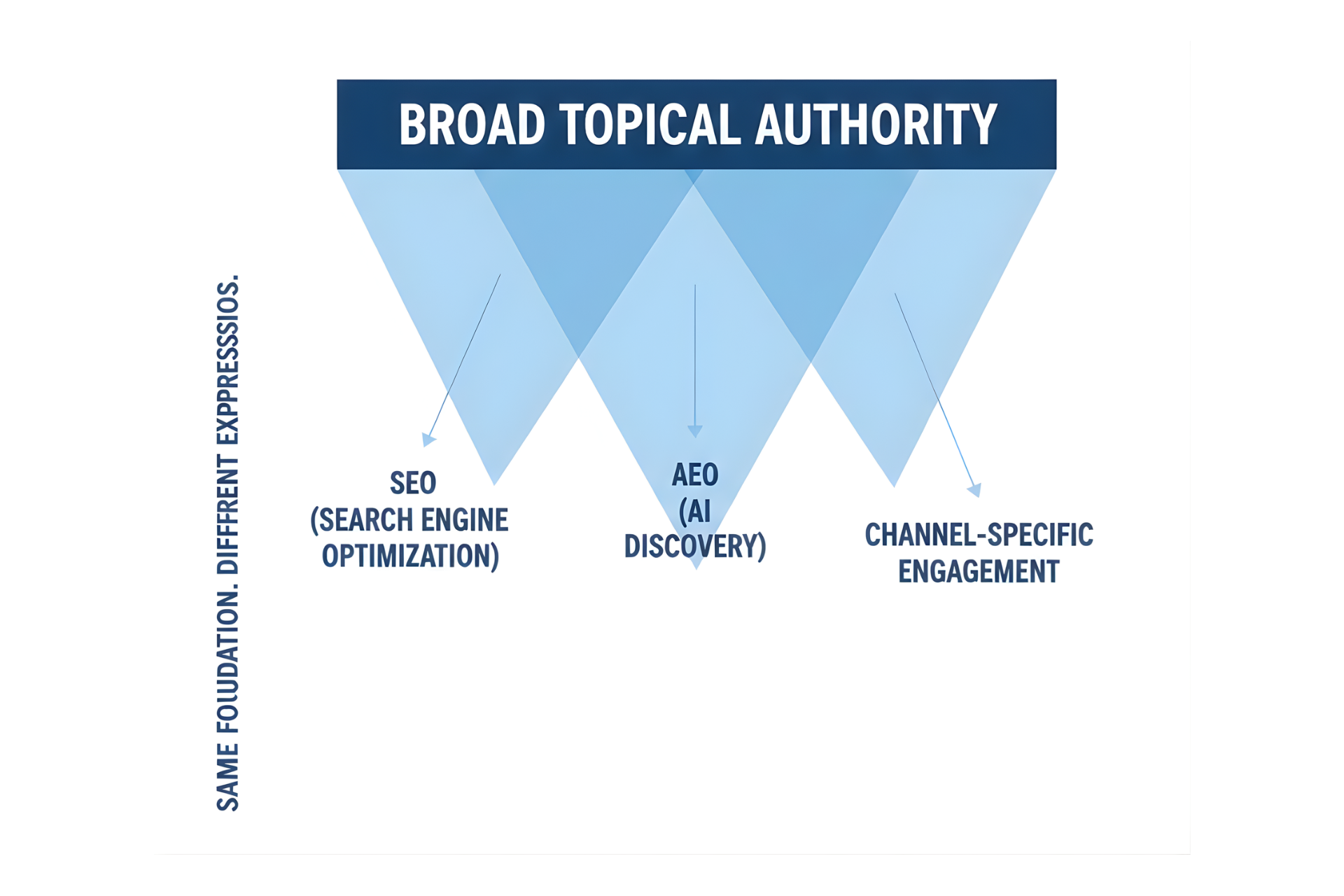
This seems pretty common sense but is important to go over because it give you the content structure needed to overlap SEO, AEO and content marketing. Content pyramids across multiple channels.
The Prompt Paradox: Human Creativity vs. Algorithmic Intent
User behavior has evolved away from the rigid, keyword-centric queries of the 2010s. Interaction with AI systems is now defined by long-form, highly specific, and often idiosyncratic prompts. Analysis of human-crafted prompts shows a Semantic Similarity score of just 0.081. In practical terms, this means that two people expressing the same underlying need often use language that is structurally unrelated. They may share intent, but not phrasing.
This is where the prompt paradox emerges. Despite the variability and apparent chaos of human input, AI systems are still able to infer intent with a high degree of consistency.
In a study of over 300 unique, highly specific prompts related to podcasting microphones, the wording varied widely. Some prompts focused on room acoustics, others on voice quality, budget constraints, or recording setup. Even so, the models consistently surfaced a stable set of microphone brands commonly associated with podcasting, including Shure, Rode, and Audio-Technica. The prompts themselves did not match. The topic did.
The implication for content strategy is clear. Optimization is no longer about matching keyword strings. As users move away from standardized queries, brands must focus on topical intent and sustained authority within a subject area rather than precision around individual terms.
This shift also reframes how zero-click should be understood. The issue is not simply that AI reduces clicks by answering questions directly. AI is now sophisticated enough to capture complex intent and provide follow-up context within the platform itself. At the same time, it is not capable of fully satisfying the human need to make a decision within a topic.
AI can narrow the field and clarify options, but it cannot complete the decision. In this environment, success is no longer defined by capturing the click. It is defined by capturing intent. Influence happens earlier, at the topic level, before a decision is finalized.
The Dual System
We are no longer operating inside a single distribution system. We are operating inside a content ecosystem that lives in a constant paradox.
Within individual platforms, content is rewarded for immediate gratification. What performs is what captures attention quickly, resolves curiosity fast, and keeps users inside the feed. Speed, clarity, and emotional pull matter because the algorithm is optimizing for short-term engagement.
At the same time, outside any single platform, brands are evaluated very differently. Across AI systems, search, and machine-mediated discovery, what matters is broader topical authority. Depth, consistency, and sustained relevance across a subject area determine whether a brand is included at all when intent is forming.
These two forces pull in opposite directions.
Inside the platform, you are rewarded for being sharp, narrow, and instantly compelling.
Across the broader market, you are rewarded for being comprehensive, credible, and consistently associated with a topic over time.
This creates a dual mandate. Content must perform in the moment while also contributing to a larger body of work that establishes authority beyond the feed. One optimizes for engagement. The other optimizes for inclusion.
The challenge is no longer choosing between them. It is learning how to balance both at once.
That tension is not a flaw in the system. It is the system.
Ryan Edwards, CAMINO5 | Co-Founder
Ryan Edwards is the Co-Founder and Head of Strategy at CAMINO5, a consultancy focused on digital strategy and consumer journey design. With over 25 years of experience across brand, tech, and marketing innovation, he’s led initiatives for Fortune 500s including Oracle, NBCUniversal, Sony, Disney, and Kaiser Permanente.
Ryan’s work spans brand repositioning, AI-integrated workflows, and full-funnel strategy. He helps companies cut through complexity, regain clarity, and build for what’s next.
Connect on LinkedIn: ryanedwards2