
From Funnels to Messages: A Guide to Connected Marketing

The End of the Linear Funnel, The Start of the Journey
For many in business, the traditional marketing funnel is a foundational concept. It’s a neat, linear model promising to guide a customer from initial awareness to a final purchase. But let’s be direct: "the old way of marketing is broken."
Today’s customer journey is not a straight line. It's a "chaotic feeling path" where people discover solutions on their own terms and timelines. This guide introduces a more potent and effective alternative: the "message-driven" approach, a strategy designed for how customers actually find solutions and connect with brands in the modern world.
The Old Model: Deconstructing the Traditional Marketing Funnel
What Was the Funnel Supposed to Do?
The fundamental idea of the marketing funnel was to organize content creation by mapping different assets to different stages of a potential customer's journey. The goal was to deliver the right type of content at the right time to move someone smoothly from one stage to the next.
The stages and their corresponding content types are typically defined as follows:
Top of Funnel (ToFu): Content to build broad awareness, such as viral shorts.
Middle of Funnel (MoFu): Content to nurture the interest of an aware audience, such as in-depth educational videos.
Bottom of Funnel (BoFu): Content to convert an interested prospect into a customer, such as a direct pitch for a course.
This model, while logical on paper, contains a fundamental flaw that renders it ineffective in the modern digital landscape.
The Core Problem: Why the Funnel Fails Today's Audience
The primary reason the traditional funnel fails is simple yet profound: "People don't follow your funnel; they follow their own path."
A strict funnel-based strategy leads to a critical disconnect that costs you opportunities. Imagine a potential customer lands on your homepage from a Google search, ready to buy. But because you’ve organized your content by funnel stage, your most persuasive, bottom-of-funnel message is completely buried, reserved only for those who have completed the "correct" steps. You met a bottom-of-funnel person with top-of-funnel content, and the connection was instantly broken.
The key insight is this: The funnel forces a company-defined, rigid path onto what is actually a customer-led, chaotic journey. This mismatch results in lost revenue and a failure to meet your audience's immediate needs, all because you organized your content by an internal process instead of by the messages people desperately need to hear. This problem necessitates a complete shift in thinking.
The New Model: "Think in Needs, Answers and Messages, Not in Funnels"
The "message-driven" approach is the modern alternative to the outdated funnel. Instead of creating content for stages, this model focuses on mapping the specific, essential messages your audience needs to hear to build trust and see value in your solution.
The core philosophy is that every single piece of content must be able to "stand alone and deliver value" no matter where or when a person discovers it. This ensures that every touchpoint is an opportunity to build authority and solve a real problem for your audience.
"If your content doesn't stand alone and deliver value regardless of where someone finds it, you are losing people."
Key Messages to Map for Your Audience
Instead of thinking about stages, successful marketers map out the core messages their audience must internalize. This involves deeply understanding their perspective and addressing it directly.
The Problem You Understand: Your content must first prove that you grasp your audience's specific pain points and can articulate them in their own language. This builds an immediate connection of trust and makes them feel seen and understood.
The "Villain" They Blame: Acknowledge the external force they see as their primary obstacle not a person, but a broken system, an outdated method, or a flawed industry standard. Blaming a shared "villain" creates powerful alignment and frames your solution not as an attack on them, but as a partnership against a common enemy.
The Failed Solutions They've Tried: Demonstrate empathy by acknowledging the other solutions they have already attempted that didn't work. This validates their struggle and is crucial for overcoming their existing biases and skepticism, clearing the path for them to be receptive to a new approach - yours.
Creating the right messages is the first step. The next is ensuring those messages are actually discoverable where it matters most.
Connected Marketing: Ensuring Your Messages Are Heard
When a creator comes to me after posting for a year with "zero results," my first question is always, "Are you creating content where AI can actually find it?" In today's landscape, creating great content isn't enough; it has to be discoverable by both humans and artificial intelligence. This is the concept behind Ask Engine Optimization (AEO).
Content is now actively indexed and used by AI platforms like ChatGPT and Perplexity to generate answers for users. These AI engines primarily pull their information from a few key sources:
YouTube
Reddit
Wikipedia
If your audience is using AI to research solutions (and they are0 but you don't appear in these sources, you literally don't exist to them.
Imagine you're investing heavily in a LinkedIn strategy because you know your audience is technically there. But a tool like SparkToro reveals that your audience is actually consuming information and finding solutions through YouTube tutorials and Reddit discussions. You have been talking to the wrong room this entire time.
The strategic imperative is clear: you must prioritize creating content for the platforms where your audience is actively searching for solutions and where AI platforms are actively indexing information. Any effort outside this intersection is a wasted investment.
At a Glance: Funnel-Based vs. Message-Driven Strategy
This table provides a clear, scannable comparison of the two approaches, distilling the key differences in their philosophy and execution.
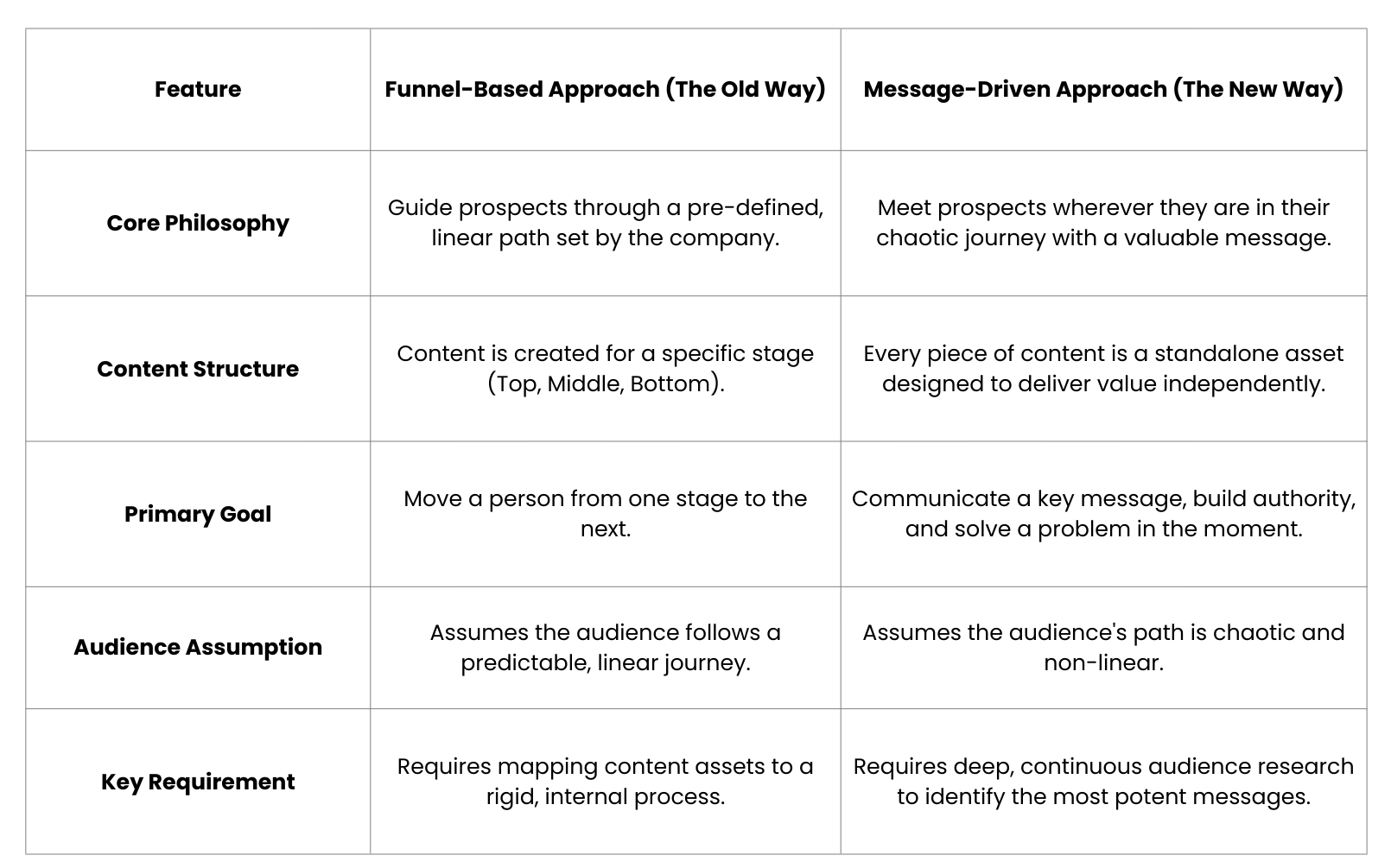
This side-by-side view highlights the fundamental shift from an internal process to an external, audience-focused reality.
The shift from funnels to messages is more than a change in tactics; it’s a strategic evolution from a rigid, company-centric model to a flexible, audience-centric one. It is a direct response to the reality that modern customers are in control of their own journey.
Embracing the message-driven approach is a strategic imperative for any marketer who wants to remain relevant. By focusing on creating standalone, valuable content that communicates core messages, you ensure that every interaction has the potential to build trust, demonstrate authority, and solve a real problem. For any creator or brand, adopting this mindset is the key to building a stronger, more engaged audience and achieving the business results that have, until now, remained out of reach.
Ryan Edwards, CAMINO5 | Co-Founder
Ryan Edwards is the Co-Founder and Head of Strategy at CAMINO5, a consultancy focused on digital strategy and consumer journey design. With over 25 years of experience across brand, tech, and marketing innovation, he’s led initiatives for Fortune 500s including Oracle, NBCUniversal, Sony, Disney, and Kaiser Permanente.
Ryan’s work spans brand repositioning, AI-integrated workflows, and full-funnel strategy. He helps companies cut through complexity, regain clarity, and build for what’s next.
Connect on LinkedIn: ryanedwards2