
The Old Marketing Playbook Is Obsolete: 4 New Rules for a Non-Linear World

Modern marketing demands trust-building, non-linear journeys, AI-driven authority, and constant experimentation where speed of learning drives competitive advantage.
Key Stat: Only 5% of B2B buyers are in-market at any time, while 60% of the decision is made before talking to a supplier.
As a modern marketer, you operate in a world of dizzying complexity. The old strategies feel increasingly ineffective as customers interact with your brand across countless channels, from social media and mobile apps to physical stores and support calls. The traditional marketing playbook, built for a simpler era, is broken.
This article cuts through the noise to reveal several surprising and impactful shifts in marketing. Drawing from recent analysis, we will distill four key takeaways that challenge the old rules and offer a clearer path forward in a world where customer attention is fragmented and the journey is anything but linear.
You're Focusing on the Wrong 95% of Your Audience
Key Stat: A single customer journey today can span 20–500 touchpoints.
The first counter-intuitive truth is that only about 5% of potential B2B buyers are actively in the market at any given time. The other 95% are not ready to buy today, but they are deciding their future purchases now by determining who they trust, who is creating value, and who is there for them when they are not buying yet.
This reframes marketing from a short-term lead generation activity to a long-term trust-building exercise. The impact of this shift is profound when you consider that 60% of buying decisions are made before a customer even contacts a supplier. Your primary job is no longer just to capture the 5% who are ready now, but to become the trusted, top-of-mind brand for the 95% who will be ready tomorrow. This long-term view is essential because the very path to purchase has fundamentally changed.
The Customer Funnel Is a Myth; We Live in a Chaotic Ecosystem
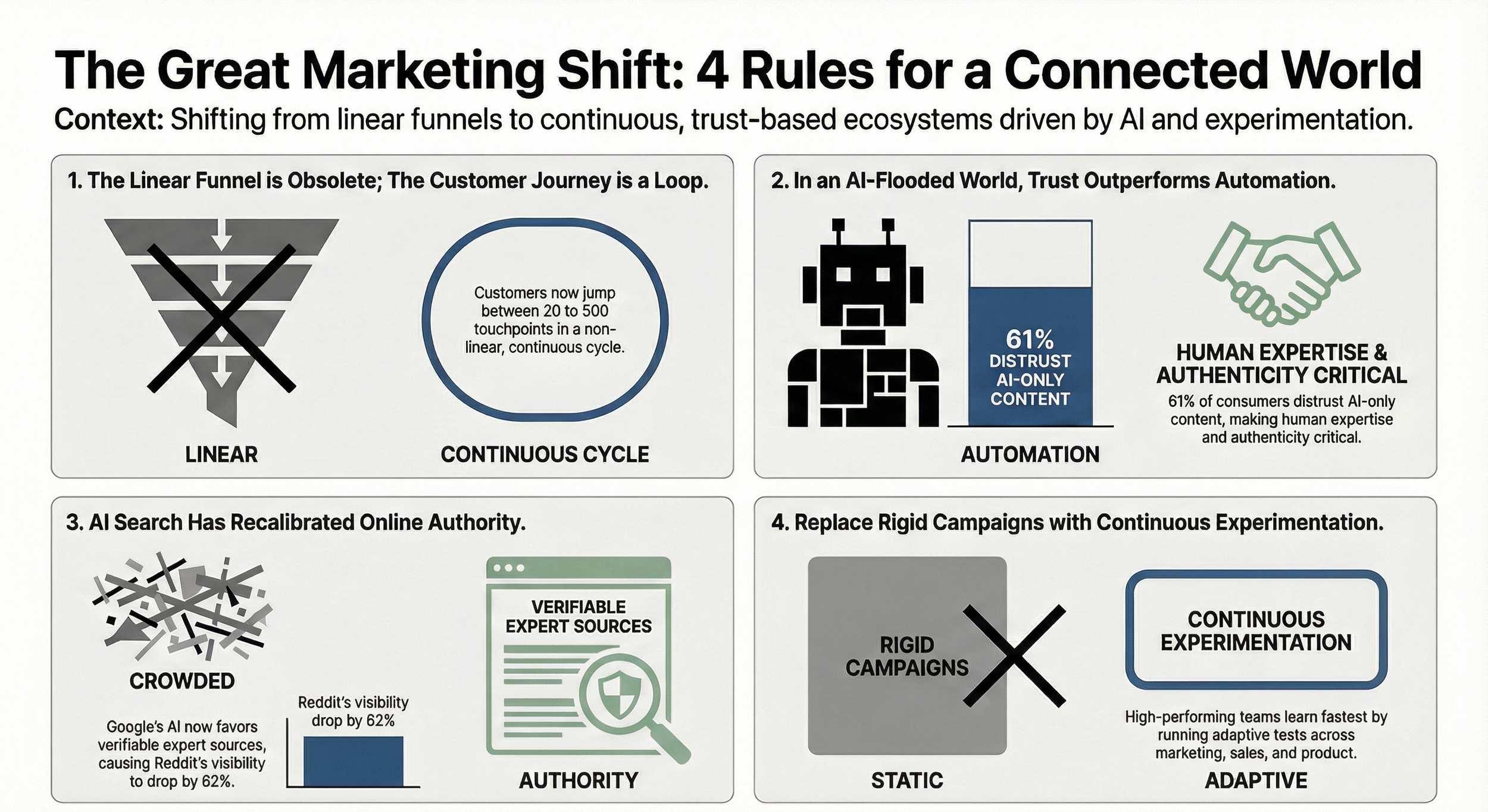
This focus on the 95% is critical precisely because the traditional, linear "AIDA" (Awareness, Interest, Desire, Action) funnel is an obsolete model for understanding the modern customer journey. Today's path to purchase is not a predictable sequence but a non-linear and continuous process where customers jump fluidly between channels. A single journey can involve anywhere from 20 to 500 different touchpoints.
The new model is best understood as a "loyalty loop" or a "connected ecosystem," where the goal is not a one-time conversion but a continuous relationship. This matters because it forces companies to break down their internal silos. When there is no predictable path to manage, the only winning strategy is to compel marketing, sales, and service teams to work together from a shared pool of customer data and insights to create a consistent and seamless experience.
Google’s AI Is Prioritizing Authority Over Authenticity
“Google’s AI is shifting from the messiness of user-generated content to the structure and credibility of authoritative entities — signaling the end of the PageRank era and the rise of PersonRank.”
For years, savvy searchers added "Reddit" to their Google queries as a shortcut to find out "what real people think," bypassing sanitized, algorithm-focused content. This user-generated content (UGC) became a proxy for authenticity. However, in a stunning reversal, a Google update in the fall of 2025 caused Reddit's visibility in AI Overviews to plummet by 82 percent.
Reddit did not simply drift out of Google’s AI systems. It was pushed. Quietly, decisively, and for reasons that expose the deepest fault line in the modern internet: who gets to define truth when AI becomes the primary interpreter of knowledge.
The reason for this dramatic shift is that Google's AI cannot anchor high-stakes answers on the "messiness, spontaneity, anonymity, and human chaos" inherent in UGC. It is recalibrating toward verifiable, structured, and institutional sources. This signals a fundamental change from valuing crowd wisdom to rewarding entity-level credibility. It’s part of Google’s larger evolution from ranking pages to ranking entities—a move from the era of PageRank to the emerging era of PersonRank, which is structurally incompatible with Reddit's core culture of pseudonymity.
The "Campaign" Is Dead. Your New Job Is Running Experiments.
Operating within the chaotic ecosystem described earlier requires a complete overhaul of how marketing gets done. The traditional marketing campaign, with its rigid six-month cycles and linear plans, is an artifact of a slower, more stable era. In today's dynamic market, high-performing teams are replacing rigid launch calendars with systems built to test, learn, and adapt in real time.
The new paradigm treats a go-to-market (GTM) strategy not as a master plan, but as a hypothesis. In this model, "experiments have become the new campaigns." The core implication is that the most successful teams are no longer the ones with the most resources or experience; they are "the fastest learners." Success is no longer determined by the most polished plan, but by a simple principle: Speed to Insight > Perfection of Plan.
What Will You Test Next?
The old marketing playbook is obsolete. The neat, linear models of the past have been replaced by a chaotic, interconnected ecosystem that demands a new approach. Success today requires embracing non-linear journeys, building long-term trust with audiences who aren't ready to buy, and operating with an agility that prioritizes learning over planning.
The edge no longer goes to the teams with the most polished plans, but to those who can learn and adapt the fastest. In a world where the edge goes to the fastest learners, what is the one experiment you'll run next?
Ryan Edwards, CAMINO5 | Co-Founder
Ryan Edwards is the Co-Founder and Head of Strategy at CAMINO5, a consultancy focused on digital strategy and consumer journey design. With over 25 years of experience across brand, tech, and marketing innovation, he’s led initiatives for Fortune 500s including Oracle, NBCUniversal, Sony, Disney, and Kaiser Permanente.
Ryan’s work spans brand repositioning, AI-integrated workflows, and full-funnel strategy. He helps companies cut through complexity, regain clarity, and build for what’s next.
Connect on LinkedIn: ryanedwards2